Your Cart is Empty


Which supplement fits the way you feel after eating, a probiotic or digestive enzymes? The better question isn't which product is universally better. It's which biological job needs support: maintaining a healthy internal environment over time, or helping process a particular meal.
Interest in this choice is understandable. Probiotic and prebiotic use among U.S. adults quadrupled between 2007 and 2012, reaching about 4 million adults, or 1.6% of the adult population, in the prior 30 days in 2012, according to the National Center for Complementary and Integrative Health. The same source reported use among 300,000 children ages 4 to 17, or 0.5%, showing that interest extended beyond adults. A 2026 study cited by the NCCIH page found probiotic supplement use rose from 1.8% to 6.96% among Americans aged 20 and older between 2009 and 2023, while use among those under 20 rose from 0.63% to 5.58%.
| Feature | Probiotics | Digestive enzymes |
|---|---|---|
| Main role | Support the microbial environment | Help break food into smaller nutrients |
| Best fit | Ongoing wellness support | Meal-specific digestive support |
| How they work | Live microorganisms | Proteins that assist digestion |
| Timing | Consistent routine, according to the label | Usually taken with a meal, according to the label |
| Key selection factor | Exact strain and formulation | Enzyme types and activity |
| What they don't do | They don't digest food directly | They don't maintain a microbial community |
Many people see both products on the same shelf and assume they perform the same function. They don't. Digestive enzymes help with the food in front of you, while probiotics support the living environment inside your digestive system.
A simple way to begin is to identify the pattern. If your concern appears mainly after a rich or unfamiliar meal, an enzyme formula may fit the situation because enzymes participate in the breakdown of macronutrients. If you're looking for general digestive wellness support as part of a daily routine, a probiotic may be the more relevant starting point.
Commercial demand reflects this focus. The gastrointestinal health segment represented 64.2% of U.S. probiotic dietary supplement revenue in 2024, according to Grand View Research's U.S. probiotic dietary supplement market report. That figure describes the market, not a guarantee for any individual, but it does show how closely probiotics are associated with digestive wellness.
Ask yourself three practical questions:
People curious about one particular enzyme can also explore a resource such as buy amylase test online to learn more about amylase and its role in carbohydrate digestion. A test or supplement shouldn't replace professional guidance, but understanding the specific enzyme can make the broader choice less confusing.
Practical rule: Match the product's mechanism to the pattern you're trying to understand. A broad “gut health” label isn't enough information by itself.
The rest of the decision becomes easier once you separate these two jobs. One is closer to kitchen preparation. The other is closer to tending a garden.
Could the same digestive symptom reflect two different needs? Digestive enzymes and probiotics support normal digestive function through separate pathways. An enzyme is a protein that breaks food into smaller components the body can absorb. A probiotic is a live microorganism that may support the balance and activity of the gut's microbial community. The useful question is not which category wins, but which mechanism matches your symptom pattern.
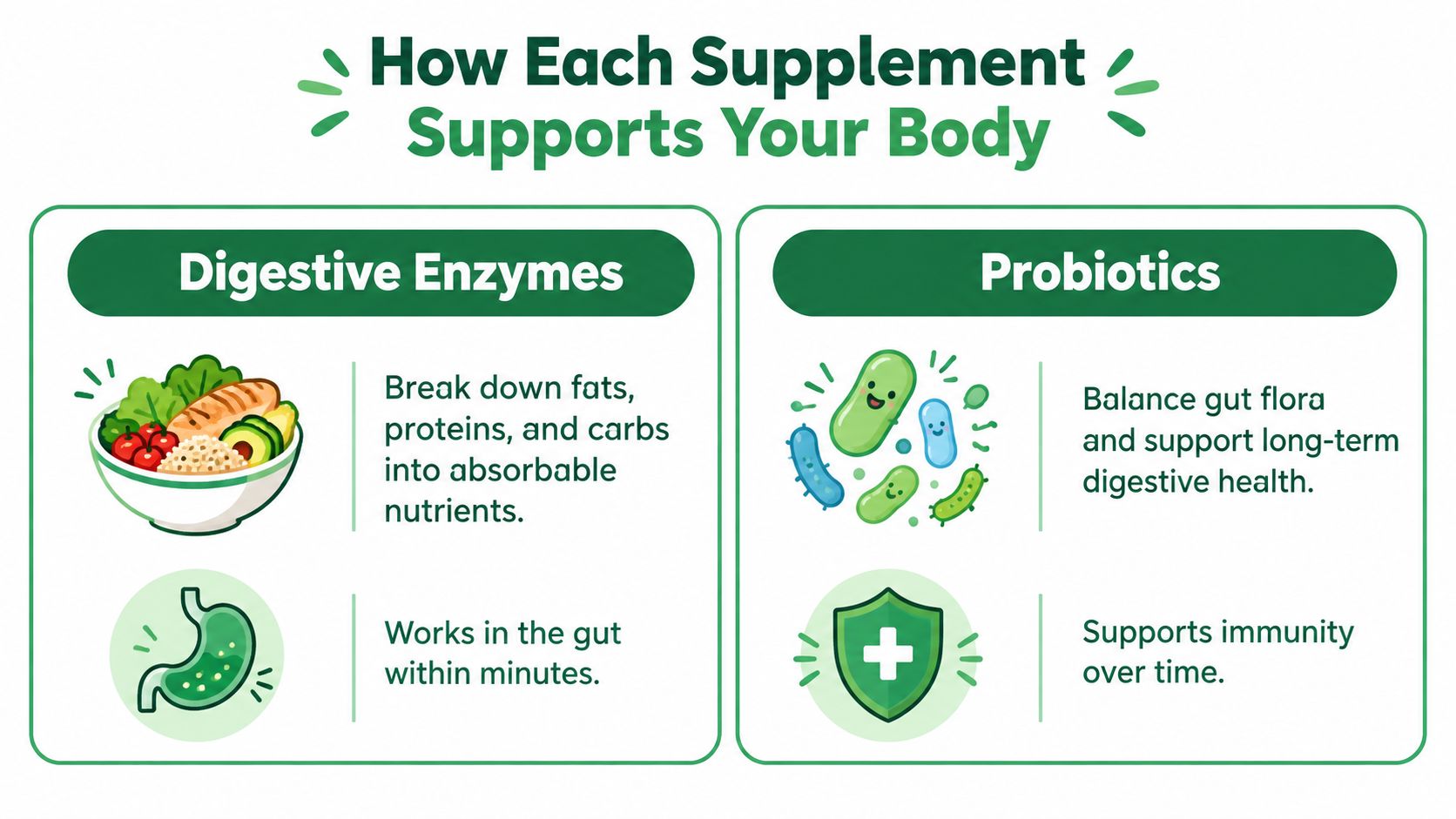
Your body uses different enzymes for different macronutrients. Amylase assists with carbohydrates, protease assists with proteins, and lipase assists with fats. These proteins do not add anything to a meal. They help separate its components into smaller pieces that the digestive system can process.
That function connects enzyme supplements with eating itself. They may seem more relevant when someone is examining how a particular meal affects them, rather than seeking ongoing support for the microbial environment. The formula also matters, since an enzyme product may contain support for one macronutrient or several.
A simulated macronutrient-digestion study reported improved digestion during gastric and intestinal phases after enzyme supplementation, including protein and fat digestion, as described in the PubMed record for the research. The same record summarizes clinical findings in which an enzyme formula was associated with improved symptom scores and sleep quality among people with functional dyspepsia, with no reported side effects. These are studied outcomes, not a promise that every person will experience the same result or a substitute for medical advice.
Probiotics are live microorganisms. They do not break a meal into nutrients. Selected strains may interact with microorganisms already present in the gut and support a healthy digestive environment over time.
A simple garden comparison clarifies the difference. Enzymes help process one meal, while probiotics provide living organisms that may influence the surrounding environment. Their effects can depend on the strain, formulation, storage conditions, and individual circumstances. A broader explanation of how prebiotics, probiotics, and enzymes differ appears in this guide to their roles in digestive wellness.
Training schedules add practical factors such as meal timing and travel. Readers can find probiotics for training at NZ Supps while considering those routine demands without assuming that one strain suits every active person.
The central distinction is clear: enzymes assist the normal physiological process of digestion, while probiotics support the internal ecosystem in which digestive activity takes place. Matching the supplement to the pattern helps avoid treating two different tools as interchangeable.
A useful comparison asks what the product does, when it acts, and how specific the formula is. It doesn't ask which category wins in every situation.
| Feature | Probiotics | Digestive Enzymes |
|---|---|---|
| Primary function | Provide live microorganisms that may support a healthy microbial environment | Assist with the breakdown of carbohydrates, proteins, and fats |
| Relationship to food | They don't digest food directly | They work on food during digestion |
| Timing | Usually part of a consistent routine, following the product label | Commonly associated with meals, following the product label |
| Main selection question | Which strains, amounts, and delivery format are included? | Which enzymes are present, and what activity does the label identify? |
| Expected role | Ongoing support for digestive wellness | Targeted support for meal processing |
| Evidence considerations | Benefits can be strain-specific | Results depend on the enzyme blend, dose, meal, and person |
| Storage concern | Viability can change with handling and temperature | Activity can also depend on formulation and storage |
| Best conceptual match | Supporting the garden | Supporting the kitchen |
Probiotics aren't interchangeable as a category. The NIH Office of Dietary Supplements consumer fact sheet on probiotics explains that probiotics are live microorganisms and that their effects can depend on the specific microorganism. That means the word “probiotic” alone doesn't tell you enough about expected function.
Digestive enzymes require a different type of label reading. A formula might contain protease, lipase, amylase, or other enzymes, but the presence of an ingredient isn't the same as proof that the finished product will suit every meal or every person. Look for clear ingredient names and meaningful product information rather than relying on a broad promise.
Suppose a meal contains foods you already know are challenging for your digestion. A meal-based enzyme formula may be the more logical mechanism to investigate. By contrast, someone seeking general support for a healthy digestive routine may prefer to assess a probiotic consistently and observe how their body responds.
That doesn't make either option universally superior. It makes them different tools for different jobs. A clear comparison of the categories is available in this digestive enzymes and probiotics guide from Yuve, but product decisions still require attention to the actual label and personal context.
A better question: “What process do I want to support?” is more useful than “Which bottle has the strongest promise?”
Which symptom pattern sounds familiar? The answer can guide the mechanism you investigate first. If heaviness or bloating appears after a substantial meal and seems closely connected to what you ate, digestive enzymes may be a reasonable option to consider. They support food breakdown, so take them according to the product directions, usually with or around the meal. For more detail, see this guide to the best time to take digestive enzymes.
A probiotic fits a different pattern. It does not process the meal directly. Instead, selected live microorganisms may support the microbial environment as part of a consistent routine. The choice depends less on which category sounds stronger and more on whether your concern is meal-specific or part of your broader digestive routine.
Consider these practical examples:
These examples are not diagnoses, and they cannot promise a particular result. They connect a symptom pattern with the biological process most closely related to it, which makes the decision more specific than choosing between two supplement categories.
Both may have a place when your goals involve separate processes. An enzyme blend supports food breakdown, while a probiotic blend may support the microbial environment. Using both can therefore make sense in principle, but it does not automatically make the plan better or more complete.
Combination products also require careful label comparison. Check whether the formula clearly identifies its enzymes, probiotic strains, directions, and serving information. A product that combines categories may offer convenience, yet it can make it harder to tell which ingredient is helping or causing discomfort.
If you choose both, introduce them thoughtfully rather than changing several parts of your routine at once. Follow each label, keep track of the foods and products involved, and assess whether the approach remains comfortable and useful. If symptoms persist, worsen, or become difficult to interpret, seek advice from a qualified healthcare professional.
The category can look simple from the front of a bottle, but product quality involves more than the ingredient list. Probiotics contain living microorganisms, so handling and storage can affect whether the product retains the characteristics stated on its label. Digestive enzyme formulas also depend on formulation, processing, and the activity of the finished product.
A 12-month study of commercial multi-strain probiotic supplements measured viable counts under ambient, refrigerated, and frozen conditions. The research described a benchmark of about 10^6 CFU/g as a minimum therapeutic level for probiotic microorganisms in food products, while also finding strain-specific differences. Some spores showed less than a 2-log reduction over 12 months, whereas less stable strains fell below that benchmark within 2 to 4 months, according to the Frontiers in Nutrition study.
The practical message is straightforward: a probiotic is only as dependable as its formulation, packaging, storage, and quality controls.

Check the product for:
A vertically integrated company controls more of the path from raw material to finished product. AloeCure states that its parent company, AGHG, farms and processes its own certified organic aloe, with on-site processing within 12 hours of harvest. Its proprietary process avoids chemicals, concentrates, enzymes, and charcoal filtration, according to the publisher's product information.
Those claims relate specifically to AloeCure's aloe supply chain, not to every probiotic or enzyme product on the market. For help evaluating labels, use this guide to reading supplement labels. The goal is not to choose the most expensive product. It's to choose a formula whose ingredients, handling requirements, and quality information you can understand.
Begin with one clear purpose. Choose a product that matches your pattern, follow the serving instructions, and avoid changing several supplements at the same time. This makes it easier to notice how your body responds and whether the product fits your routine.
For a digestive enzyme, pay attention to its relationship with meals. For a probiotic, consistency and storage instructions matter because the formula contains living microorganisms. Keep a simple note of the product, timing, meals, and how you feel. You don't need a complicated tracking system.
The FDA permits dietary supplement structure/function claims when they describe the ingredient's role in normal body structure or function and don't make disease claims, as explained in the FDA compliance guide. The required disclaimer is:
These statements have not been evaluated by the Food and Drug Administration. This product is not intended to diagnose, treat, cure, or prevent any disease.
Use that standard when evaluating supplement marketing. A responsible product description should explain what an ingredient is intended to support without promising a medical outcome.
AloeCure offers a Pre+Probiotic & Digestive Enzyme Blend that combines probiotic strains with digestive enzymes for everyday digestive support, alongside its vertically integrated organic aloe products. Visit AloeCure to review the formula, explore Subscribe & Save for 20% off, and choose a routine that fits your wellness goals.
Comments will be approved before showing up.