Your Cart is Empty


You're halfway through your morning routine when your knee feels unusually noticeable as you stand from the bed. Nothing dramatic has happened, yet the first few steps make you pay attention to how your leg bends, bears weight, and finds its balance. That everyday experience is a useful starting point for understanding joint capsule function, because the capsule does much more than wrap around a meeting point between bones.
A person may notice a joint most when a familiar movement feels different, such as reaching overhead, turning in a chair, or walking across uneven ground. These moments offer a useful starting point for understanding joint capsule function. The capsule helps enclose a synovial joint, supports smooth motion, and sends position-related information to the nervous system while working with cartilage, ligaments, muscles, and synovial fluid.
The capsule is more than a protective wrapper. Its structure helps manage movement, its inner lining contributes to the joint's fluid environment, and its nerve supply helps the body sense pressure, vibration, and position. A review of joint anatomy describes the capsule as highly innervated despite being poorly vascularized, a combination that helps explain its sensory role (joint capsule anatomy review).

This sensory control system works like a feedback loop. Signals from capsule tissues help the nervous system adjust muscle activity as a joint bends, bears weight, or changes direction. That does not make the capsule the only factor in movement. Daily comfort also reflects the surrounding chain, including footwear, walking surfaces, activity habits, rest, hydration, and leg alignment.
These details can make wellness choices easier to evaluate. Dietary supplements may support structure and function, but they are not intended to diagnose, treat, cure, or prevent disease. Vertically integrated aloe quality cues, such as clear attention to cultivation, processing, and product consistency, can also provide practical information when comparing plant-based options. They are quality considerations, not guarantees of a specific outcome.
Footwear is another everyday choice. If shoes are part of your mobility routine, this buying guide for painful feet offers practical points to consider when comparing supportive designs.
This guide examines the capsule's layers, its roles in stability and body awareness, common supplement ingredients, and responsible quality cues for plant-based joint products.
The articular capsule encloses a synovial joint, surrounding the space between two moving bone surfaces. Its outer fibrous layer and inner synovial membrane work together to contain the joint, guide movement, and maintain a suitable environment for motion. This articular capsule anatomy overview shows how these two layers fit together.
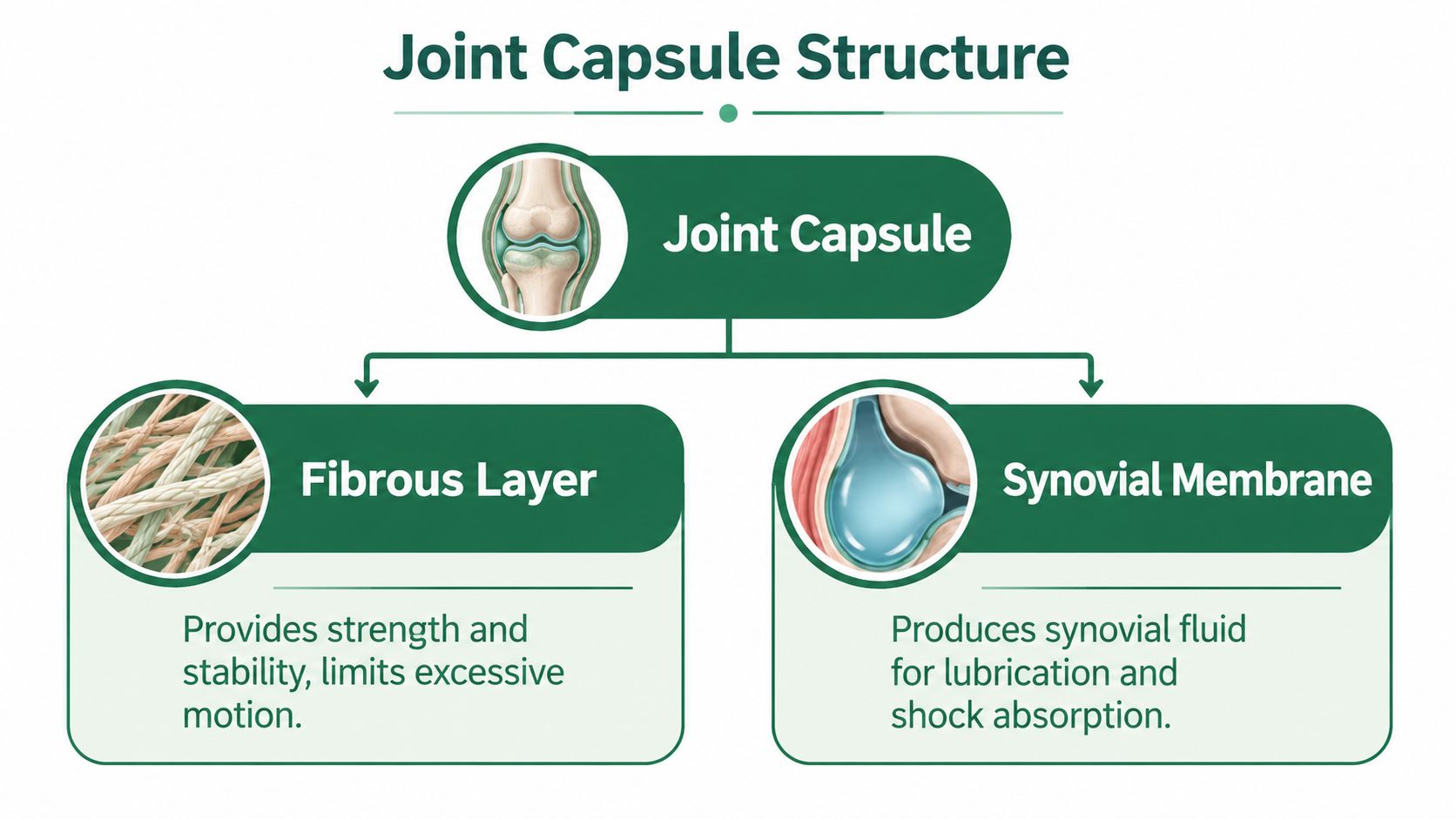
The outer fibrous layer consists mainly of dense irregular collagenous connective tissue. Its fibers point in different directions, helping the capsule handle forces from multiple angles. This layer usually continues into the periosteum, the connective tissue covering the bone, and may receive added support from capsular ligaments and nearby tissues. A review of synovial-joint histology describes this layered organization.
The capsule therefore acts as a flexible boundary. It helps enclose the joint and limits movement when tissues become tensioned near a joint's usual range. It is not a rigid container. Its connective tissue can accommodate ordinary motion while contributing passive support in particular positions.
Its sensory role adds another layer of function. Stretch and pressure within capsular tissues can provide information about joint position and movement, giving the nervous system feedback for coordinating nearby muscles. The capsule is therefore part of a control system, not only a wrapper around the joint.
The inner synovial membrane lines the joint cavity but does not cover the articular cartilage. Cells within this membrane produce and regulate synovial fluid. That fluid helps reduce friction, supports the cartilage environment, and helps distribute forces as joint surfaces move.
The arrangement is easier to separate into three parts:
The membrane and cartilage have different jobs. Cartilage supplies the low-friction interface, while the synovial membrane supports the surrounding fluid. Together, these structures allow movement within a contained space.
Capsule design differs across the body. The shoulder prioritizes a broad range of movement, while the hip combines mobility with a deeper socket and stronger reinforcement. Each capsule reflects the demands placed on its joint, linking tissue structure with stability, lubrication, and body awareness.
During a step, the hip capsule senses stretch as the joint extends. That information helps the nervous system time nearby muscle activity and manage the movement. Joint capsule function therefore includes more than support and lubrication. The capsule also contributes to controlled motion and body awareness.
The fibrous capsule provides passive stability by limiting movement as its tissues become tensioned. In an in vitro hip study, capsular strain during flexion reached about 100% in the proximal to distal direction and roughly -40% in the circumferential direction (hip capsule strain study). The findings show how much the capsule can deform while the joint moves.
The same source also reports that resistance to rotational laxity decreased after capsulotomy, with the largest reduction during external rotation. In practical terms, the capsule helps manage rotation before muscles respond. It works with, rather than instead of, active muscular control.
In the hip, the iliofemoral, ischiofemoral, and pubofemoral ligaments reinforce the capsule. The zona orbicularis, a circular band of capsular fibers around the femoral neck, adds another stabilizing element. Together, these structures resist distraction in neutral positions and help limit unwanted edge-loading during extreme flexion and extension (hip capsule stabilizers).
The synovial membrane produces and regulates synovial fluid within the joint. This fluid helps reduce friction, supports the cartilage environment, and distributes pressure as the joint surfaces move. Smooth movement depends on this fluid setting as well as on the cartilage surfaces themselves.
A daily example is the difference between a controlled step and a sudden, poorly timed reach. As the hip changes position, the capsule's tissues experience changing tension. Muscles can then adjust force and timing, while the capsule and ligaments help guide the range of motion. This coordination makes the capsule part of a larger movement system, not an isolated sleeve.
Capsular and ligament tissues contain mechanoreceptors that respond to changes in stretch, tension, and position. Ruffini endings occur throughout the fibrous capsule, while Golgi tendon organs in joint ligaments communicate information about tension and joint position to the central nervous system (joint mechanoreceptors).
This feedback helps the nervous system estimate joint position without visual checking. That ability is called proprioception, and it supports coordinated movement, balance, and protective reflex control. Capsule receptors may also help signal excessive extension or flexion, so sensory changes can matter alongside physical changes in stability (capsule sensory function).
Practical support choices should match this system. Gentle, controlled movement can help you pay attention to range, balance, and comfort. This guide to yoga for joint health offers an educational starting point. For broader information about regenerative approaches, review orthopedic stem cell therapy at Dream Body. These resources do not replace individualized professional guidance, but they can support more informed questions.
Joint-support formulas usually combine ingredients with different supportive roles. One ingredient may be associated with connective tissue structure, another with cartilage-related building blocks, and another with plant-based polysaccharides. The right comparison starts with the label, not with a dramatic promise.
The table below uses FDA-compliant structure and function language. These phrases describe general wellness support and normal physiological roles, not diagnosis or disease treatment.
| Ingredient Type | Supportive Role | Structure Function Phrasing Example |
|---|---|---|
| Aloe-derived polysaccharides, including acemannan | Provides plant-based support for connective tissue and everyday wellness routines | Supports healthy joint function |
| Collagen | Supplies amino acids associated with connective tissue structure | Helps maintain normal connective tissue structure |
| Glucosamine | Commonly included in formulas focused on cartilage and joint structure | Supports healthy cartilage function |
| Chondroitin | Often paired with glucosamine in joint-support formulas | Helps maintain normal joint tissue structure |
| MSM | Provides a sulfur-containing compound used in wellness formulas | Provides targeted support for joint wellness |
| Botanical extracts | Adds plant-derived compounds selected for a formula's intended wellness focus | Supports the body's natural processes |
| Minerals | Contributes nutrients involved in normal body functions | Assists the body in normal physiological processes |
Aloe-derived compounds deserve careful label attention. Acemannan is a plant-based polysaccharide associated with aloe, and formulas may use aloe-derived ingredients as part of broader support for healthy joint function. The product label should identify the ingredient form, serving information, and any relevant testing or certification details rather than relying on a vague reference to “aloe.”
Label-reading principle: Match each ingredient to a clear supportive role, then check whether the serving information and sourcing details are equally clear.
Formulas vary, and sourcing and processing can affect consistency. If you're comparing plant-based approaches, this overview of natural support for joint pain may help you think through ingredients and everyday wellness habits without treating a supplement as a medical solution.
A responsible formula discussion also distinguishes between supporting normal function and promising a specific outcome. Phrases such as “supports healthy joint function,” “promotes normal flexibility,” and “helps maintain normal mobility” stay focused on structure and function. They don't promise to diagnose, treat, cure, or prevent disease.
Oral capsules move through the body's normal digestive and absorptive pathways. Plant compounds are processed during digestion, and absorbable components can then enter circulation for use by body tissues. The practical question isn't how to force this process, but how to build a consistent routine that follows the product label.
Start with the serving size printed on the container. Don't assume that taking more will provide more support, and don't combine several products with overlapping ingredients without reviewing their labels or asking a qualified healthcare professional.
Use these practical checks:
The phrase “best results” shouldn't imply a guaranteed outcome. Daily consistency helps maintain normal body functions, but individual responses differ. A simple journal can show whether you're following the routine reliably and how your overall wellness habits fit together.
A capsule can't replace movement practice, adequate rest, or sensible activity progression. Gentle mobility work, walking that matches your current ability, hydration, and recovery breaks can all support a balanced routine. If you have personal health needs, use the bioavailability of supplements guide as general education and consult a healthcare professional for individualized advice.
Don't change a supplement routine around a medical procedure, pregnancy, breastfeeding, or personal medication use without professional guidance. Structure and function language keeps the focus on wellness, while qualified advice helps you account for individual circumstances.
Quality starts before a capsule reaches the bottle. For plant-based products, look for clear sourcing, traceability, processing information, serving details, and independent quality checks. These details help you compare consistency and transparency rather than relying on broad claims.
A vertically integrated producer controls more stages of the process. AloeCure's parent company, AGHG, owns and operates its aloe farms, harvests USDA- and EU-certified organic aloe, processes it on-site within 12 hours of harvest, and produces its own products. That structure can make it easier to trace raw material handling from farm to finished formula.
Processing choices matter because harsh chemicals, charcoal filtration, concentrates, and unnecessary enzymes may change the character of a plant-based formula. A company that farms, processes, and manufactures within its own operation can apply consistent standards across those stages, although shoppers should still review the finished product label.
For more context on plant-based formulations, explore this plant-based joint supplement guide. The goal isn't to assume that one format suits everyone. It's to choose a product whose ingredients, processing, testing, and directions are easy to understand.
A quality-focused routine should also fit your budget and habits. Subscribe and Save options can provide 20% off subscriptions, while a 90-day money-back guarantee, fast processing, and free shipping on qualifying orders may reduce friction for shoppers who prefer regular delivery. Review the current terms before ordering because offers can change.
Joint capsule function becomes easier to understand when you connect the pieces. The fibrous layer helps enclose and stabilize the joint, the synovial membrane supports a lubricated environment, and nerve endings provide information about position and tension. Muscles and ligaments work with the capsule to guide movement, while daily habits influence how consistently you support normal mobility.
Use this simple plan:
Choose supportive language and realistic expectations. Dietary supplements can support normal body functions, but they aren't intended to diagnose, treat, cure, or prevent any disease.
These statements have not been evaluated by the Food and Drug Administration. This product is not intended to diagnose, treat, cure, or prevent any disease.
AloeCure offers plant-based aloe products, including VeraFlex Healthy Joint Support, with sourcing and processing information for shoppers who want to evaluate daily joint wellness options. Visit AloeCure to review the product pages, purchase a formula that fits your routine, or sign up for Subscribe & Save to receive 20% off subscriptions and explore current shipping and guarantee terms.
Comments will be approved before showing up.