Your Cart is Empty


The most popular advice about melatonin vs magnesium gets the decision backward: choose the stronger supplement, take it before bed, and expect better sleep. That skips the question that matters most: Are you trying to change when you feel sleepy, or address difficulty settling down when bedtime arrives?
These supplements aren't interchangeable, and “natural” doesn't make them equivalent. A useful comparison starts with what researchers measured, how large the benefits were, and whether the participants' sleep concerns resemble yours.
Melatonin is a sleep-timing signal, while magnesium is an essential mineral with a modest and less certain link to falling asleep. Neither deserves a universal recommendation just because it's widely available.
Melatonin and magnesium compared on the same criteria
| Factor | Melatonin | Magnesium |
|---|---|---|
| Primary role | Circadian timing signal | Essential mineral linked to normal nerve and muscle function, with sleep connections through nutritional status |
| Best-studied use | Shifted schedules and falling asleep earlier | Falling asleep in older adults with poor sleep |
| Size of randomized evidence | Broader randomized evidence directly measuring sleep outcomes | A smaller collection of randomized trials, particularly in older adults |
| Reported effect | Modest average gains in sleep-onset latency and total sleep time | Modest falling-asleep signal, with uncertain total sleep time gains |
| Common label format | Tablets, capsules, gummies, sublingual products | Oxide, citrate, glycinate, and blends |
| Long-term safety data | Short-term use appears relatively safe; long-term safety isn't established | Digestive tolerance needs attention; short trials don't establish indefinite-use safety |
| Main caution | Effects differ with population, dose, timing, and study quality; not a predictable sedative | Check elemental dose, kidney health, and other sources of supplemental magnesium |
Popularity doesn't settle the comparison. According to the Council for Responsible Nutrition's survey, 16% of U.S. supplement users reported taking melatonin in 2024, compared with 23% taking magnesium, as reported by Nutritional Outlook.
That finding describes supplement use, not sleep-specific effectiveness. People can take magnesium for reasons unrelated to bedtime, so its wider use shouldn't be mistaken for stronger sleep evidence.
A supplement can have a plausible role in the body without reliably changing sleep. Likewise, a larger evidence base can support a small average benefit rather than a dramatic one.
The useful distinction is between fit and strength. Melatonin has a clearer connection to timing, while magnesium's sleep evidence is narrower and more dependent on who was studied.
Shopping rule: Match the ingredient to the sleep pattern you notice, not to the word natural on the package.
Before comparing brands, describe the problem in ordinary language. “I'm sleepy too late” is a different starting point from “I'm tired at bedtime but take a long time to settle,” and both differ from “I keep waking during the night.”
Melatonin helps communicate biological night. Magnesium supports normal physiological functions that include nerve and muscle activity, but it doesn't deliver the same nighttime signal.
The distinction is easier to understand when the pathways are separated.
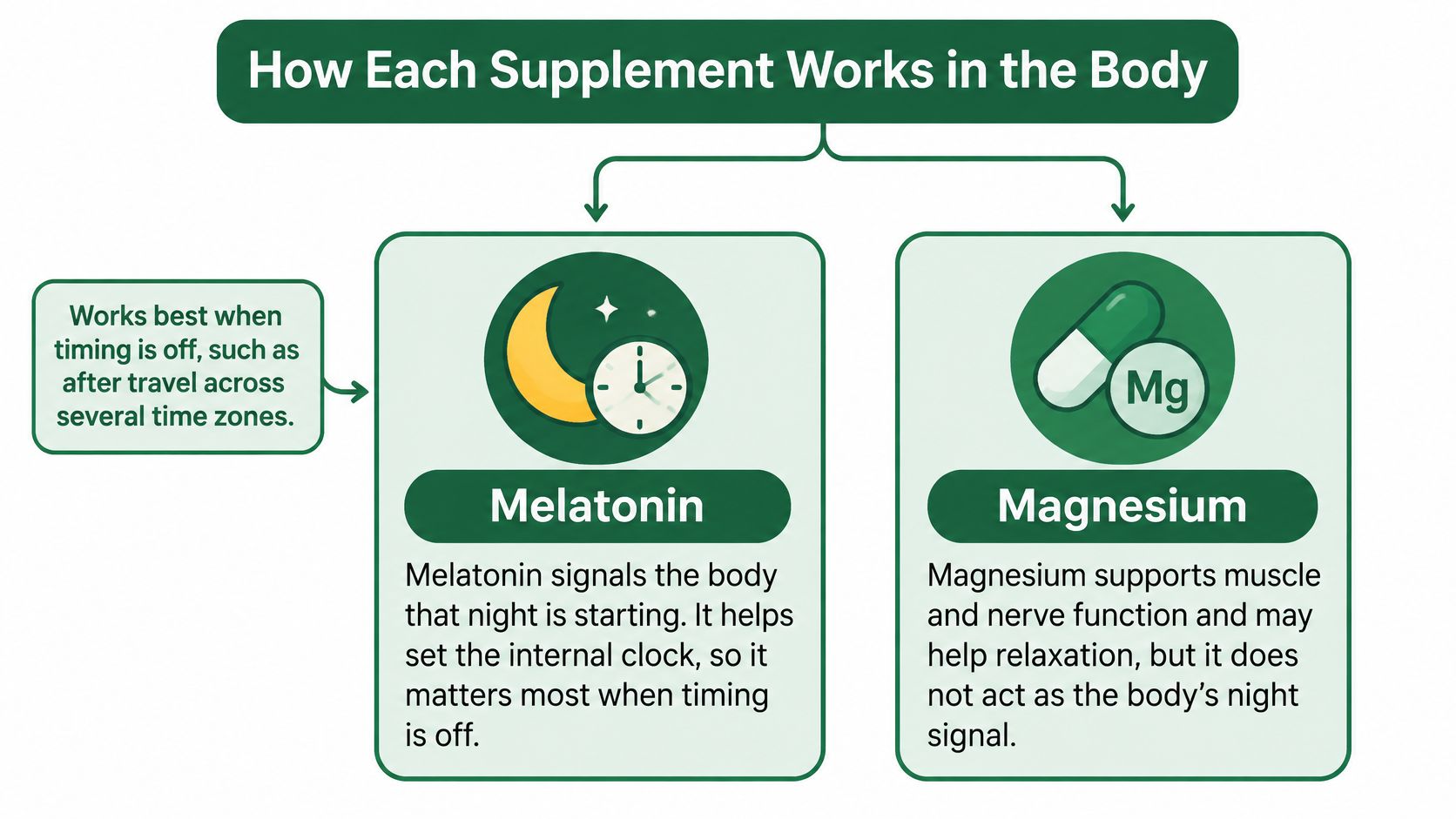
The National Center for Complementary and Integrative Health's melatonin overview explains melatonin's relationship with the sleep-wake cycle and discusses its potential relevance to travel-related schedule changes and shift work. That makes its biological role more specific than promoting a general sense of calm.
Magnesium's rationale starts elsewhere. It's an essential nutrient involved in normal cellular function, so the sleep question concerns whether additional intake changes outcomes, not whether the mineral is necessary for health.
Melatonin tells the body when night has arrived, while magnesium supports systems involved in settling down. Supporting those systems doesn't guarantee that extra magnesium will improve sleep.
The sequence looks like this:
Say you return from travel and feel alert at the local bedtime. That's a timing question, even if you describe the experience as being unable to wind down.
By contrast, someone with an unchanged schedule and restless evenings has a less specific problem. Magnesium's physiological role makes it reasonable to examine intake, but it doesn't identify the cause of that person's sleep difficulty.
This video offers another way to consider the distinction.
Neither supplement creates sleep independently of your routine. Keep a consistent schedule, pay attention to evening light, and seek clinician guidance for ongoing concerns. Tonight's useful question is: Is the problem the clock, or a body that doesn't wind down?
Sleep-onset latency means the time it takes to fall asleep. Total sleep time means time asleep, while sleep efficiency describes the proportion of time in bed spent sleeping.
Those outcomes aren't interchangeable. Falling asleep sooner doesn't necessarily mean fewer awakenings, longer sleep, or a more refreshed morning.
The chart highlights why study size belongs beside every claim about effectiveness.
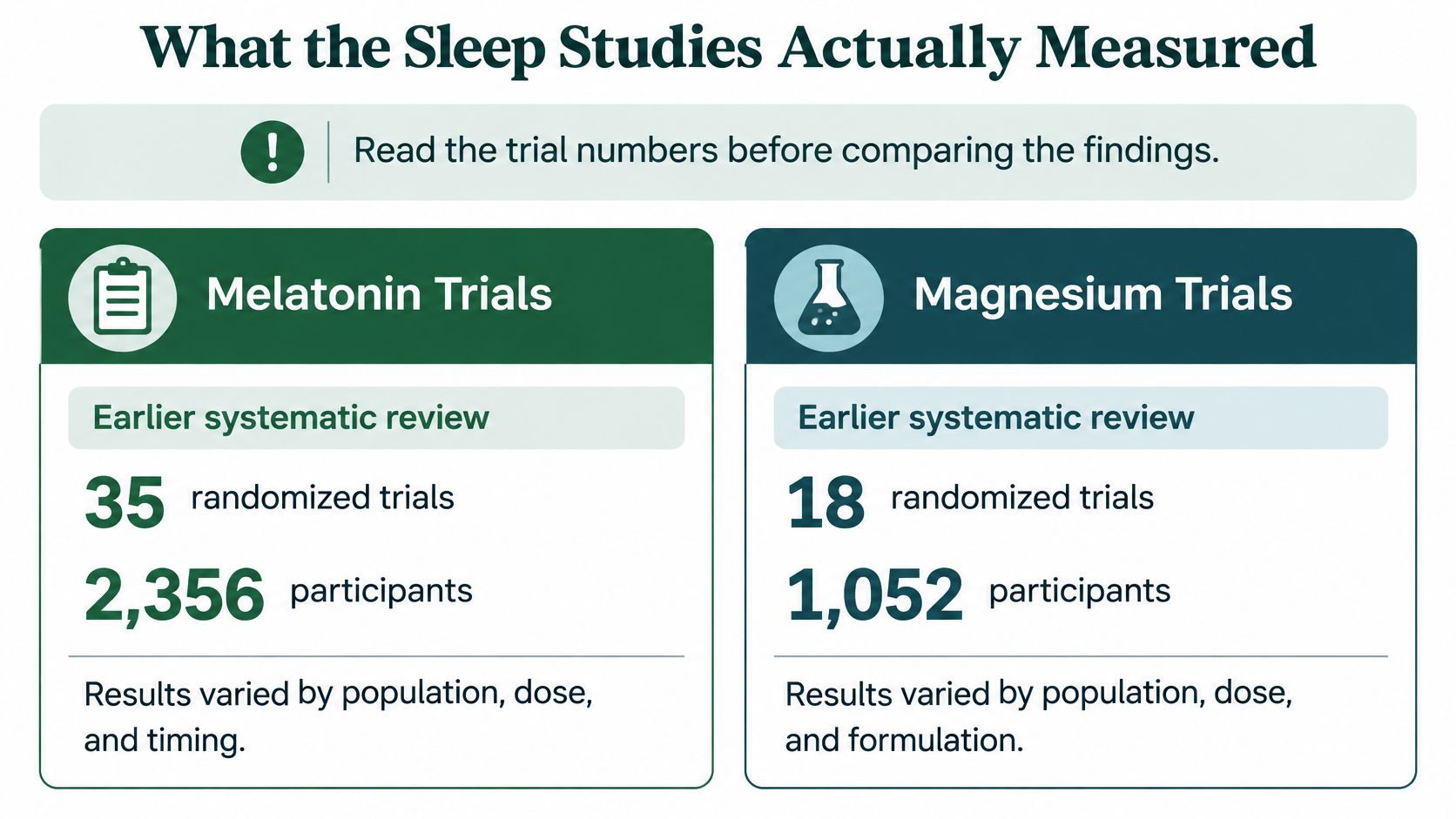
A systematic review published in Nutrition Journal identified 35 randomized controlled trials involving 2,356 participants, but findings differed by population, dose, and study quality. Of the eight favorable high-quality trials, six included only 6–23 participants each.
That's a broader evidence base, not uniformly strong evidence. Very small trials can offer useful signals without providing dependable expectations for everyone shopping for a supplement.
For magnesium, a systematic review in Biological Trace Element Research examined nine observational, cohort, and randomized studies involving 7,582 adults. Observational links between magnesium status and sleep were clearer than the randomized findings, which left the supplementation question uncertain.
Reported effects from the key studies
| Measure | Melatonin | Magnesium |
|---|---|---|
| Studies and participants | 15 mostly crossover trials, 284 participants | 3 randomized trials, 151 older adults |
| Sleep-onset latency vs placebo | 7.5 minutes faster on average | 17.36 minutes faster, with a 95% confidence interval from −27.27 to −7.44 minutes |
| Total sleep time vs placebo | 12.8 minutes more on average | About 16 minutes more, not statistically significant |
| Sleep efficiency vs placebo | 2 percentage points better | No pooled estimate specified in the review summary |
| Newer placebo-controlled trial | No directly matched newer trial specified for this comparison | 155 adults, 250 mg elemental magnesium daily for four weeks; small effect, Cohen's d = 0.2 |
The melatonin meta-analysis summarized in the Nutrition Journal review supports small average improvements, not a reliably dramatic change in sleep. The magnesium review suggests a possible falling-asleep benefit in older adults, while the newer magnesium trial requires particular attention to formulation and effect size.
It would be misleading to compare the latency figures and conclude that magnesium works better. These estimates came from different participants, study designs, and evidence bases, not a direct contest under identical conditions.
A statistically significant result also doesn't tell you whether the difference will feel worthwhile. Conversely, a nonsignificant increase in sleep time isn't proof of no possible effect, but it doesn't establish a dependable benefit.
Both sets of findings are modest and limited in scope. Neither supplement should be presented as a guaranteed fix, and a plausible mechanism shouldn't substitute for a measured sleep outcome.
Choose a starting point by describing what happens at night, not by ranking ingredients. The following scenarios separate a better-supported fit from a reasonable hypothesis that still needs checking.
Sleep goals and the better-supported starting point
| Sleep goal | Better-supported starting point | Why it fits | Check first |
|---|---|---|---|
| Schedule shift after travel across time zones | Melatonin | Targets the body's timing signal | Dose timing relative to the new local night |
| Irregular work rota and early or late shifts | Melatonin, with individualized timing advice | Addresses misaligned timing rather than general restlessness | Whether rest-day timing fits the overall schedule |
| Trouble falling asleep, no clear timing cause | A gradual magnesium trial may be considered | Modest falling-asleep signal in older adults with poor sleep | Elemental dose and a defined evaluation period |
| Waking during the night | Routine review and clinician assessment | Neither supplement has strong randomized evidence for this goal | Room temperature, evening routine, and persistent patterns |
| Evening muscle tension and restlessness | Magnesium as nutritional support | Supports normal muscle and nerve function | Total supplemental magnesium across products |
| Suspected low dietary magnesium | Magnesium after clinician advice | Matches a nutritional-status rationale | Dietary assessment, whether testing is appropriate, and existing health concerns |
The placebo-controlled magnesium bisglycinate trial enrolled 155 adults and used 250 mg elemental magnesium daily for four weeks. Sleep symptom scores improved more with magnesium than placebo, but the between-group effect was small, with Cohen's d = 0.2.
That supports a measured, gradual approach rather than expecting an immediate sedative effect. It also doesn't establish that oxide, citrate, gummies, or multi-ingredient products will reproduce the same findings.
For a formulation-focused comparison, our guide to choosing a magnesium supplement can help you distinguish the mineral form from the elemental amount. If your concern is broader than supplement selection, Refresh Psychiatry & Therapy's resource on ways to find relief from sleepless nights offers additional context for discussing persistent sleep difficulties.
Different mechanisms don't establish that taking both produces a larger benefit. Starting both together also makes it harder to identify which ingredient contributed to a change or an unwanted effect.
Practical distinction: A combination can be convenient without being better supported than either ingredient alone.
For readers considering a melatonin product, AloeCure's Melatonin + Collagen Sleep Support Capsules cost $14.95 USD. Our fully vertically integrated operation farms our aloe, processes it, and produces our products, with on-site aloe processing within 12 hours of harvest.
That farm-to-product oversight is a concrete quality-control distinction, not proof of superior sleep results. Subscribe & Save provides 20% off every order, and our products carry a 90-day money-back guarantee.
Wording such as supports healthy sleep-wake signaling describes normal function rather than promising a medical outcome. The FDA's structure/function guidance requires such claims to be truthful, substantiated, and not misleading.
These statements have not been evaluated by the Food and Drug Administration. This product is not intended to diagnose, treat, cure, or prevent any disease.
The label detail that matters most for magnesium is elemental magnesium, not the weight of the entire compound. A larger compound-weight number on the front of a package doesn't necessarily mean more magnesium per serving.
Start with Supplement Facts, then check serving size. Compare the amount you'll take, including any overlapping ingredients in multivitamins or evening blends.
Label checks and reference values
| Check | What to look for | Reference point |
|---|---|---|
| Melatonin strength | Milligrams per serving on Supplement Facts | No universal amount established for every sleep goal |
| Melatonin timing | Instructions aligned with the intended sleep window | Don't assume a stronger tablet compensates for unsuitable timing |
| Magnesium form | Elemental amount, not compound weight | Bisglycinate trial exposure is a study reference, not a personal recommendation |
| Total daily supplemental magnesium | Every magnesium-containing supplement and relevant nonfood product | Adult upper intake limit described below |
| Evaluation period | A defined review point and sleep log | Short study duration doesn't establish indefinite-use safety |
The NIH Office of Dietary Supplements magnesium fact sheet sets the adult Tolerable Upper Intake Level at 350 mg per day from supplements and medications, excluding magnesium naturally present in foods and beverages. Adults shouldn't exceed that amount unless a healthcare provider recommends it.
That limit isn't a daily target. Nor does staying below it guarantee suitability for someone with impaired kidney function or another relevant health concern.
For example, a standalone magnesium capsule and a multivitamin both contribute to supplemental intake. Read both labels before deciding whether an evening blend adds an unnecessary duplicate.
The NCCIH consumer guide to stress and complementary approaches discusses why supplement safety needs individual attention. Melatonin's reported unwanted effects can include headache and dizziness, while magnesium can cause digestive effects, including loose stools.
Melatonin appears relatively safe for short-term use, but long-term safety isn't established. Magnesium requires extra caution when kidney function is impaired because the body may not clear excess magnesium normally.
Our overview of melatonin side effects can help you prepare questions before starting. Don't assume that a familiar ingredient or a small serving removes the need for a compatibility check.
Bring these details to a clinician or pharmacist:
The idea that magnesium is automatically gentler is too simple. These products may support everyday wellness, but they aren't substitutes for individualized medical advice.
Use the opening fortnight to observe a pattern, not to keep increasing the amount until something happens. A written record gives you and your clinician more useful information than a general impression that you slept better or worse.
Loud snoring, gasping, or pronounced daytime sleepiness warrant a professional assessment rather than another supplement purchase. The Pain and Sleep Therapy Center's guidance on why to confirm sleep apnea before choosing treatment provides context for that conversation.
Keep your schedule and evening light habits consistent, and use our guide to improving sleep quality naturally to organize the routine around your trial. Bring the sleep log to your appointment so the discussion starts with observable patterns.
AloeCure offers Melatonin + Collagen Sleep Support alongside practical guidance for choosing support that fits your sleep goals. Visit AloeCure to review the product details and consider Subscribe & Save for 20% off every order.
Comments will be approved before showing up.