Your Cart is Empty

Aloe vera gel clear means the transparent inner-leaf gel, about 99 percent water. A clear look alone doesn't prove purity, aloin level, or preserved polysaccharides.
If two jars look equally transparent, how can you tell which one contains carefully handled aloe? You need to know which part of the leaf was used, what happened after harvest, and what the finished material was tested for.
The useful distinction isn't clear versus cloudy. It's appearance versus a documented path from leaf to finished formula.
Clear aloe vera gel describes the slippery, transparent material inside an aloe leaf. A review of aloe composition describes fresh gel as approximately 99% water, with the remaining fraction containing polysaccharides, amino acids, lipids, sterols, vitamins, minerals, enzymes, and phenolic compounds.
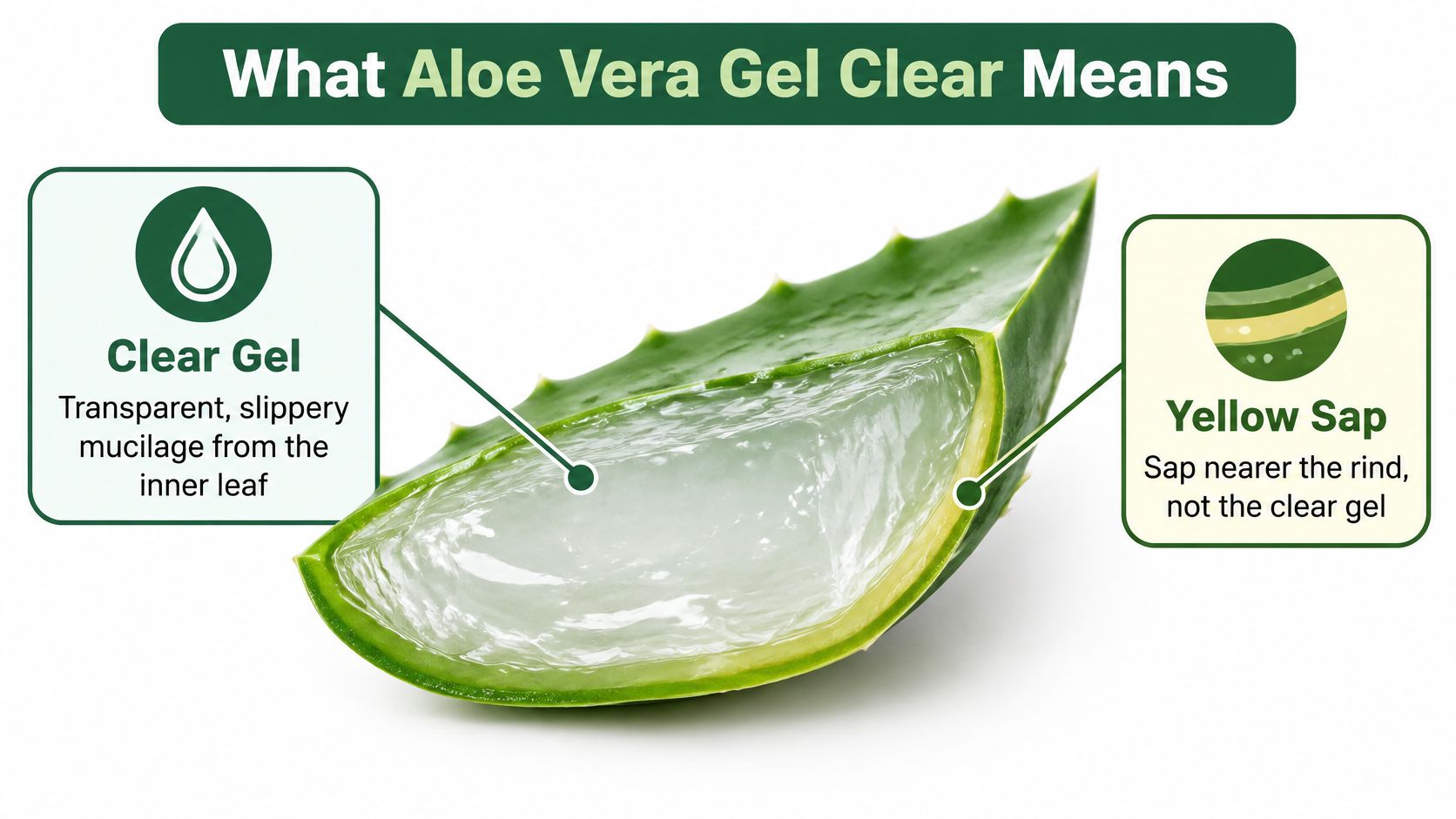
Think of a leaf as a water-filled fillet inside a tougher skin. If you cut across it, the fleshy center looks different from the green rind and the yellow sap nearer that rind. Those aren't interchangeable ingredients.
The leaf cross-section makes the distinction easier to recognize.
The water doesn't sit inside the leaf like water in a drinking glass. It's held within a soft plant matrix containing polysaccharides, long carbohydrate molecules that contribute to the gel's texture.
An important example is acetylated glucomannan, commonly discussed as acemannan. It helps explain why the fresh material feels slippery and cohesive rather than pouring exactly like plain water.
Say you lift a freshly separated inner fillet with a spoon. It may bend, slide, and leave a slick coating on the utensil. That texture comes from the relationship between water and the plant's gel-forming components, not from transparency itself.
Aloe plants don't produce identical material under every growing condition. Cultivar, maturity, cultivation, harvesting, and processing all influence the final composition.
That's why a long ingredient inventory isn't the same thing as evidence about a particular jar. Naming naturally occurring compounds doesn't tell you how much remains after manufacturing or whether a finished formula has been diluted.
Clarity is useful for understanding the leaf's water-rich interior and familiar texture. It doesn't certify the route from that interior to the bottle.
| Material | Where it comes from | Look and feel | What clear does not prove |
|---|---|---|---|
| Inner-leaf gel | Fillet inside the leaf | Transparent, slippery, about 99% water | Not proof of aloin level or preserved polysaccharides |
| Cloudy or stored gel | Inner gel after time, cold, or breakdown | Hazy, separated, or thinner | Cloudiness is a handling clue, not a full quality verdict |
| Yellow latex | Sap just under the rind | Yellow and bitter | A clear finished gel should not depend on this fraction |
| Decolorized whole-leaf material | Whole leaf after color removal | Can look clear after filtration | Looking clear is not the same as an untouched inner fillet |
Inner-leaf gel is the fillet many people have in mind when they search for clear aloe. Its identity describes a location within the plant, not just the appearance of a manufactured liquid.
A finished product may contain that material alongside ingredients that change thickness, spreadability, or storage behavior. For that reason, compare the plant-part description with the complete ingredient list rather than judging the jar alone.
Cloudy or stored gel requires a different question: what changed? Time, storage conditions, separation, or deterioration can affect appearance, but a hazy sample doesn't identify its own cause.
Check the storage instructions, expiration information, package integrity, and any unexpected change in smell or texture. Don't assume that cloudiness proves a product is poor, and don't use transparency to dismiss other warning signs.
Yellow latex is a separate fraction near the rind. It isn't clear gel with a stronger color, and its presence shouldn't be interpreted as evidence of a more complete or more useful aloe ingredient.
Decolorized whole-leaf material begins with a different starting ingredient. The National Institute of Environmental Health Sciences explains that processors commonly decolorize whole-leaf extracts to remove aloin, a latex-associated compound.
That distinction matters when comparing labels. Inner-leaf and decolorized whole-leaf describe different material choices, even when the finished liquids look similar.
Clear describes appearance and can describe the inner-leaf material. It doesn't guarantee that latex compounds are absent or that polysaccharides stayed intact.
Consider an edge case: a heavily filtered liquid may look exceptionally glassy without retaining the same marker profile as its starting material. A lightly handled inner fillet may look less polished without changing its plant-part identity.
Neither example establishes a winner by sight. You need the processing description and analytical results to understand why two clear products differ.
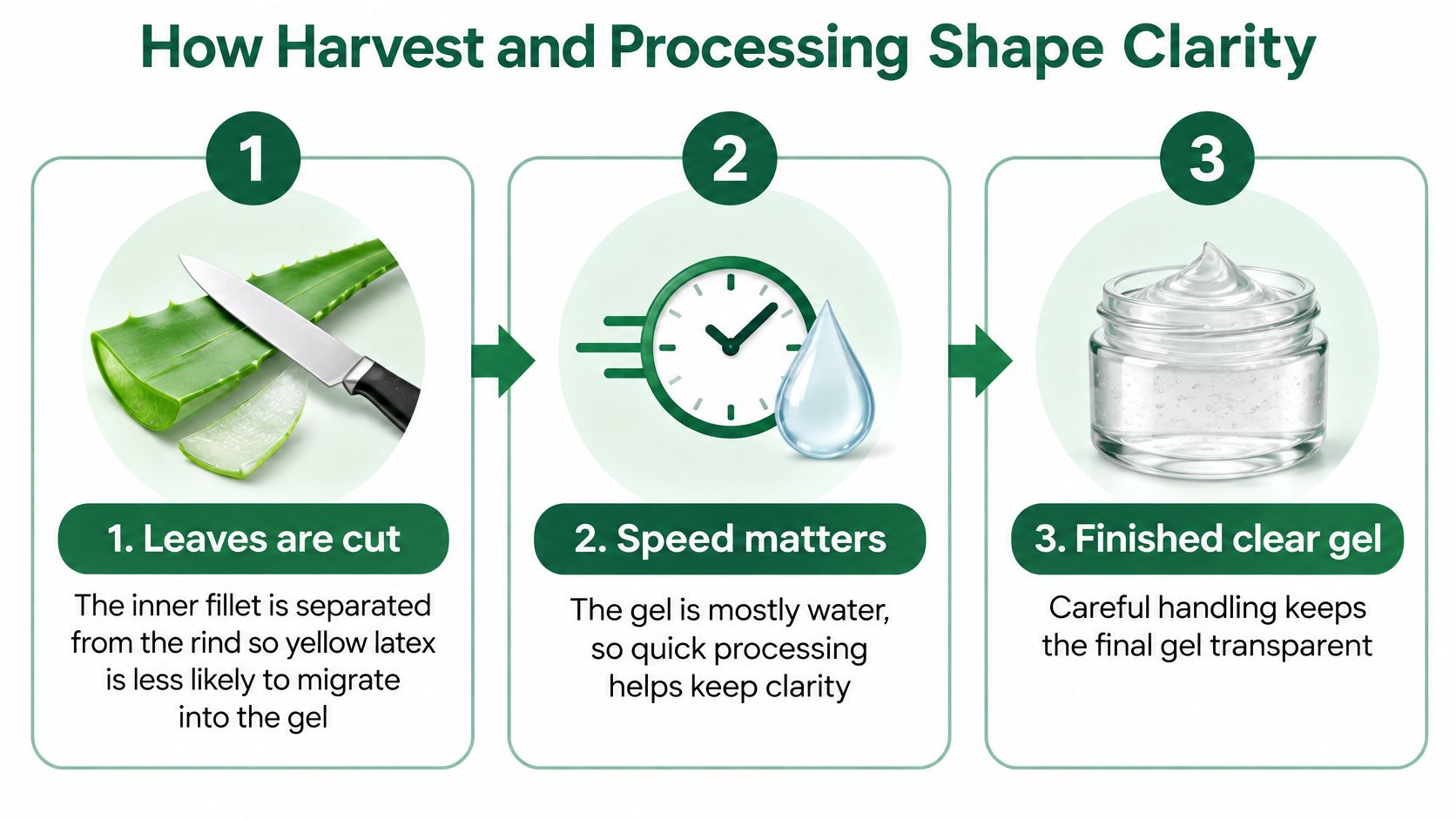
The leaf-to-gel path begins before a bottle is filled. How workers separate the leaf, how promptly they process it, and which refining steps they use all affect what reaches the finished formula.
This overview shows the basic handling sequence.
The aloe vera technical information sheet discusses commonly cited IASC aloin benchmarks of less than 10 ppm for oral aloe gel and a maximum of 50 ppm for topical use.
Those are use-specific quality benchmarks, not a reason to assume every transparent product meets them. HPLC, high-performance liquid chromatography, can measure aloin A and B rather than relying on color as a substitute.
A meaningful testing program also needs representative sampling across production lots. One attractive sample doesn't establish the consistency of everything a manufacturer ships.
The video offers another way to follow the handling process.
Charcoal filtration is a processing choice, not automatic evidence of a better or worse finished product. It removes compounds nonspecifically, so its use should be understood alongside aloin, polysaccharide, microbial, and stability results.
At AloeCure, we use a proprietary, patented process without added processing chemicals, enzymes, concentrates, or charcoal filtration. That describes our route; analytical checks remain important because appearance can't replace verification.
A transparent pour can't show whether acemannan survived processing. A useful specification pairs appearance with measurements of plant solids, freshness indicators, and polysaccharide markers.
The International Aloe Science Council publications provide a quality framework that includes the whole-leaf gel benchmarks and dry-matter marker below. These are reference points for the relevant material, not universal specifications for every flavored drink, capsule, or finished cosmetic.
| Marker | Benchmark | What it tells you |
|---|---|---|
| pH | 3.5–4.7 | Whether the gel sits in the expected acid range |
| Total solids | About 0.46–1.31% | How much is plant material versus water |
| Malic acid | About 817.8–3427.8 mg/L | A freshness signal in whole-leaf gel standards |
| Lactic acid | Rise above the fresh profile | A possible sign of microbial change |
| Succinic acid | Rise above the fresh profile | A possible sign of enzymatic breakdown |
| Aloverose | At least 5% of dry matter for tested raw material | A polysaccharide marker stronger than transparency |
pH describes acidity. It helps a quality team compare material with its expected specification, but an acceptable pH doesn't establish the full identity or quality of the aloe.
Total solids describe what remains beyond the water fraction. For raw gel, that helps distinguish a meaningful plant-material profile from a liquid that is mostly added water. In a finished formula, other ingredients can contribute solids, so the result needs context.
Malic acid is useful as a freshness indicator. Lactic acid and succinic acid serve different purposes: unexpected increases can flag microbial or enzymatic changes that deserve investigation.
Aloverose on a dry-matter basis needs careful reading. It describes a share of the material after water is excluded, not the same percentage of the entire bottled liquid.
Practical rule: A lab result is useful only when you know what was tested, which method was used, and whether the sample matches the material you're buying.
A certificate of analysis should identify the material and lot, then show the applicable tests and results. Avoid treating a generic specification sheet as proof that a particular production batch passed.
Useful entries include:
Our explanation of third-party testing helps distinguish an independent check from a marketing statement.
A high water reading isn't automatically a quality advantage. Heavy dilution can also produce a beautifully clear liquid, so read water content alongside solids and marker results.
Short-term oral aloe gel use of up to 42 days appears safe, according to the National Center for Complementary and Integrative Health. The agency also describes adverse effects associated with latex and case reports involving oral products used from three weeks to five years, summarized below.
That doesn't establish an open-ended daily-use schedule. It also doesn't extend the gel finding to yellow latex or every whole-leaf preparation.
| Use case | Duration or source | Reported finding |
|---|---|---|
| Short-term oral gel | Up to 42 days | Reported as appearing safe |
| Oral aloe latex | Yellow fraction near the rind | Abdominal pain, cramps, and diarrhea reported |
| Ongoing oral aloe products | Three weeks to five years of use | Serious liver effects reported in case reports |
| Anyone taking medicines | Any duration | Check with a healthcare professional first for possible interactions |
First, confirm that the product is intended to be swallowed. A skin gel isn't an oral supplement, even if aloe appears prominently on its label.
Next, establish the ingredient identity. Our explanation of what aloin is helps clarify why the latex-associated fraction needs separate attention.
Then consider duration and personal circumstances. There isn't enough information here to recommend cycling a product on and off as a way to make indefinite use safe.
Case reports don't tell an individual shopper how likely a problem is. They do show why natural origin and a clear appearance shouldn't replace a thoughtful safety decision.
Start with the verbs. Supports, promotes, and helps maintain can describe normal body functions, but those words don't automatically make a statement appropriate.
Under FDA structure/function claim guidance, these statements aren't pre-approved. The manufacturer must possess evidence showing that each claim is truthful and not misleading.
Normal-wellness wording can follow patterns such as:
These are wording examples, not a list of established benefits for every aloe product. Each finished product needs substantiation appropriate to its actual composition and statement.
Compare those patterns with a plant-part description such as inner-leaf juice. That identifies an ingredient rather than promising a physiological effect.
A shopper should skip a statement that ties the gel to fixing a named health problem or replacing professional care. A mild verb doesn't make the surrounding message acceptable if the overall impression promises a medical outcome.
The required disclaimer belongs prominently beside qualifying statements, or in a properly connected box on the same panel or page. It isn't permission to make unsupported claims.
These statements have not been evaluated by the Food and Drug Administration. This product is not intended to diagnose, treat, cure, or prevent any disease.
Keep these distinctions separate when reading a label:
Organic certification and inner-leaf identity can be valuable facts. Neither independently establishes that every wellness sentence on the package is supported.
An honest label makes these categories easy to distinguish. It shouldn't require a shopper to infer ingredient quality from a broad promise on the front panel.
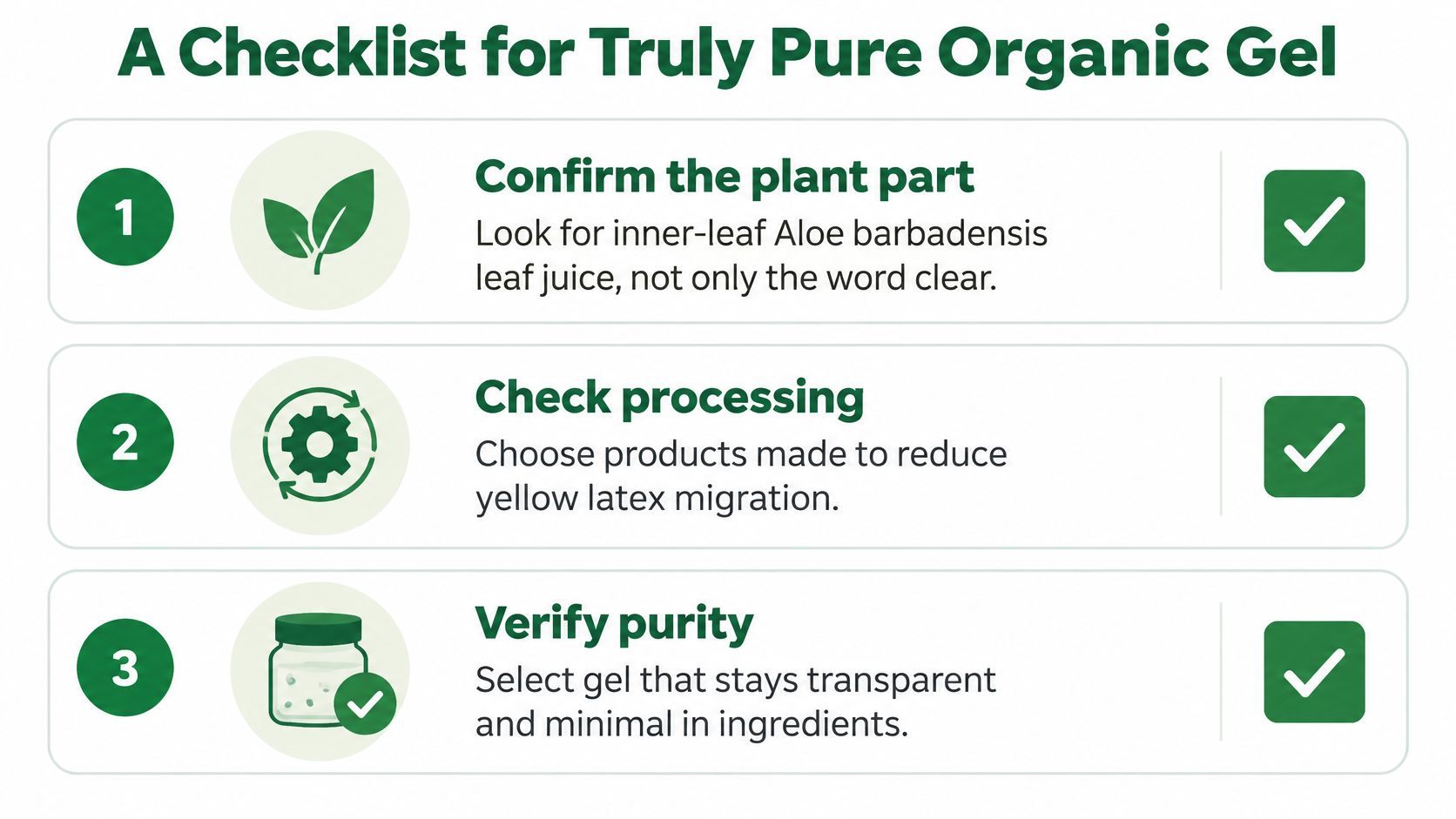
Use the package and supporting documentation together. The strongest purchase decision connects plant identity, manufacturing choices, and finished-material checks rather than collecting reassuring words.
The checklist below highlights the core purchase checks.
Avoid interpreting chemical-free as a literal composition claim. Aloe naturally contains chemical compounds, and a stable skin formula can contain additional ingredients without misrepresenting its aloe source.
The standard to seek is clear accountability: a company that can connect the growing leaf, processing decisions, and finished goods. That's more useful than a transparent jar with an unknown route.
Choose the production path before choosing the package size. At AloeCure, our parent company, AGHG, has owned and operated its aloe farms for 25 years, with hand-harvesting on USDA- and EU-certified organic farms and on-site processing within 12 hours.
We farm the aloe, process it, and make our own products. That integrated route provides a concrete basis for comparing quality with products whose ingredient supply and processing history aren't disclosed. It doesn't require assuming that every competitor uses the same method.
Our patented, entirely natural processing route avoids added processing chemicals, enzymes, concentrates, and charcoal filtration. The meaningful comparison is the documented process and finished-material verification, not a claim that the clearest jar must be best.
A finished skin gel brings that sourcing story into a practical formula.
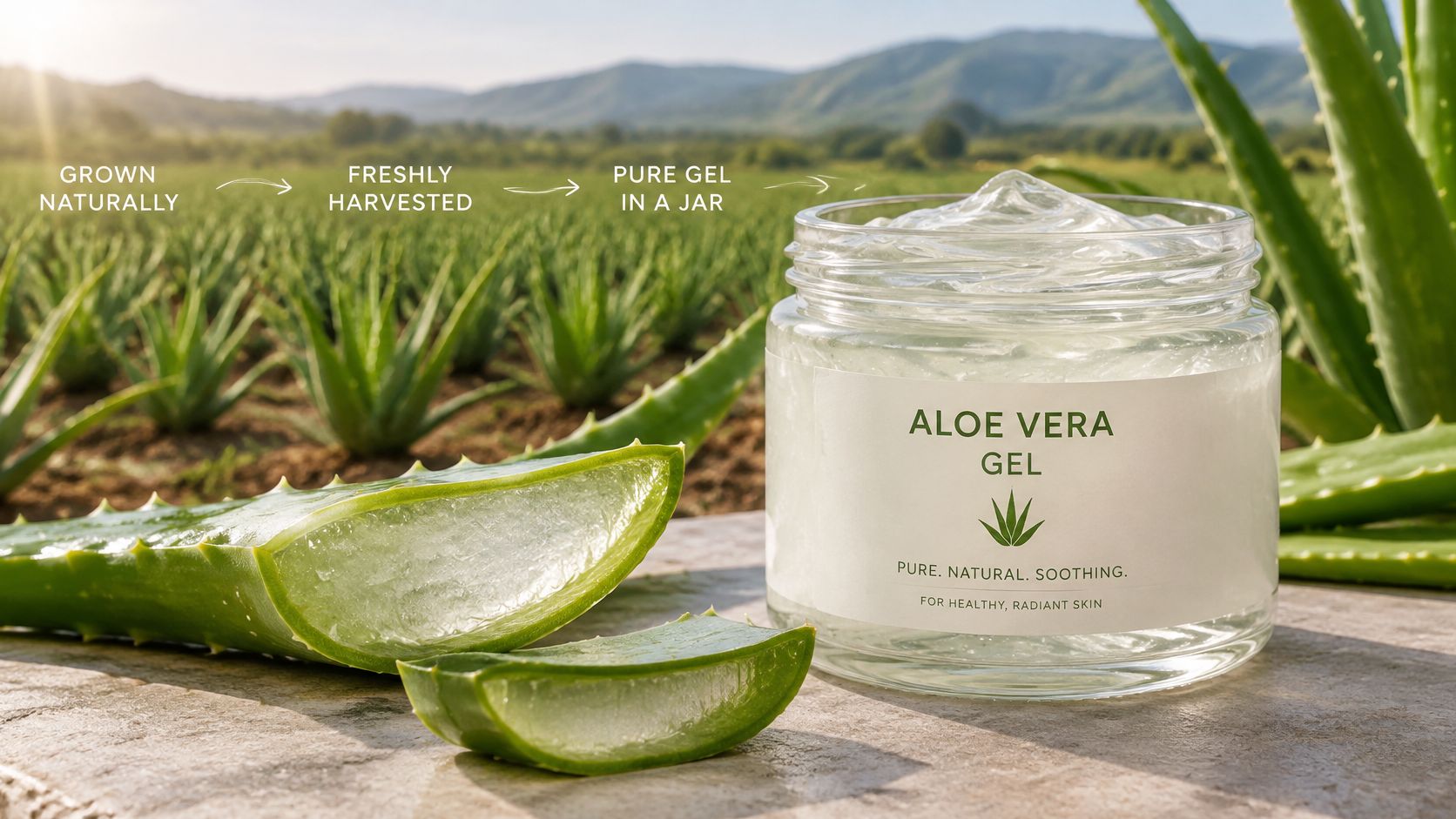
ALODERMA, our sister skin-care line, offers Pure Aloe Vera Gel in sizes from 45 g to 500 g, made with fresh certified-organic aloe processed within 12 hours of harvest. The 45 g formula lists organic Aloe Barbadensis leaf juice, Carbomer, 1,2-Hexanediol, Hydroxyacetophenone, Tetrahydroxypropyl Ethylenediamine, and Disodium EDTA.
That ingredient line illustrates why fresh aloe sourcing and formulation helpers aren't contradictory. A skin gel can prioritize leaf juice while including ingredients that help create a usable, stable texture.
For another label-reading reference, aloe vera skincare from Vitamin Planet offers a topical product listing to compare for intended use and ingredient disclosure. Compare those details rather than treating retailer descriptions as laboratory verification.
Use our juice and capsule pages when shopping for an oral aloe format, and our ALODERMA gel pages when shopping for skin care. Keep supplement claims and their disclaimers together, as explained in the FDA dietary-supplement labeling guide.
These statements have not been evaluated by the Food and Drug Administration. This product is not intended to diagnose, treat, cure, or prevent any disease.
The purchasing details matter too. Subscribe & Save offers 20% off with flexible delivery, alongside fast priority processing and a 90-day money-back guarantee.
AloeCure offers organic aloe juices, capsules, and ALODERMA skin care backed by our farm-to-finished-product approach. Visit AloeCure to compare formulas, choose the format intended for your use, and explore Subscribe & Save for 20% off.
Comments will be approved before showing up.