Your Cart is Empty


You're standing in front of a shelf of amber bottles, trying to decide whether your skin needs vitamin E, retinol, or the blend promising a brighter-looking complexion. At home, there's already a moisturizer by the bathroom mirror. What would another oil add, and how can you tell whether its vitamin content matters?
A useful answer starts with the formula, not the promise on the front label. Vitamin skin oil can support a comfortable, well-maintained complexion, but the vitamin, carrier, packaging, and directions all deserve a closer look.
Vitamin skin oil is a broad shopping term, not a precise formula description. It usually refers to an oil-based product containing vitamin E, a vitamin A ingredient, or an oil-compatible vitamin C derivative. The surrounding oil is the carrier, the base in which the vitamin is delivered.
That distinction matters at the bathroom mirror. A product sold mainly for a soft, conditioned finish isn't necessarily comparable to a carefully formulated retinol product, even if both come in small glass bottles. Start by asking what the manufacturer intends the formula to do, then check whether the ingredient list and directions support that purpose.
The familiar bottle format can make very different products look interchangeable.

Think of the label as answering distinct questions:
A vitamin name alone can't answer all of those questions. Nor does a long ingredient list establish that a formula is more capable than a simple one.
A facial oil is an external-use product. A dietary supplement belongs to a different category, with its own directions and labeling requirements. Don't swallow a facial oil or apply an oral supplement to your face unless the product is expressly designed and labeled for that use.
For ordinary skincare shopping, the realistic expectation is daily maintenance of skin comfort and appearance, not a guaranteed transformation. Persistent concerns deserve professional evaluation rather than an increasingly complicated collection of bottles.
The letters on the label aren't interchangeable. Vitamin E has a substantial history in topical formulations, retinol has some defined clinical evidence for fine wrinkles, and vitamin C requires especially careful attention to delivery.
Use this comparison as an orientation, not as proof that every pictured benefit applies to every product.
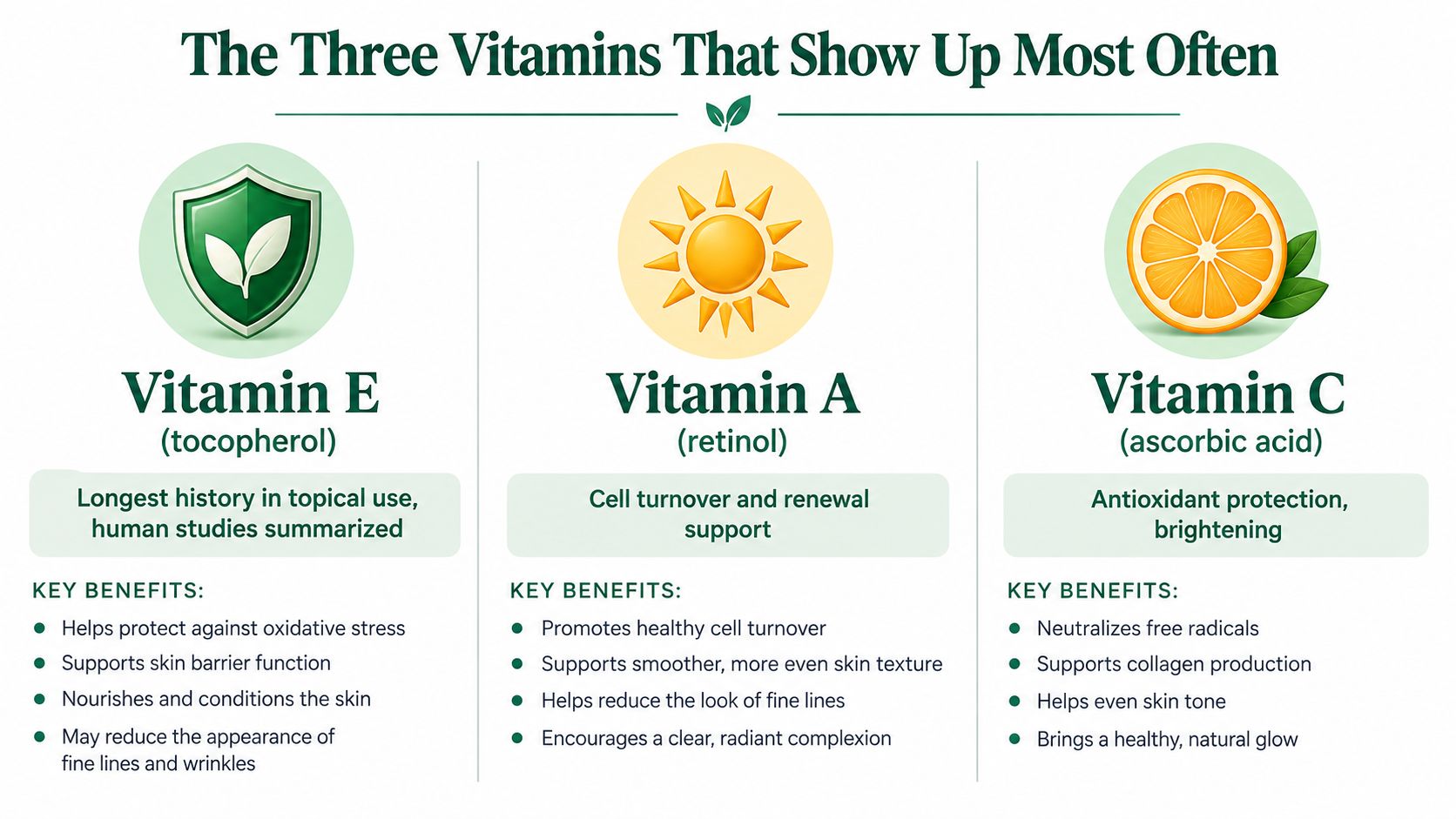
Look for tocopherol or tocopheryl acetate rather than relying on a front-label vitamin E badge. Those names identify different ingredient forms, and evidence about one shouldn't automatically be assigned to the other.
By 2005, vitamin E had accumulated more than 50 years of clinical and experimental use; human research summarized by Oregon State University's Linus Pauling Institute on vitamin E and skin health reported reduced oxidation of skin-surface lipids and reduced UV-associated redness, while two small studies found improved water-binding capacity after 2–4 weeks, with broader moisturizing evidence still characterized as limited.
That's a useful distinction. An antioxidant finding describes a biological effect, while improved water binding describes a hydration-related measurement. Neither establishes that an unspecified vitamin E oil will erase fine wrinkles or deliver every cosmetic benefit advertised beside it.
The same review found more consistent topical efficacy with unesterified vitamin E. Treat that as a reason to investigate ingredient form, not as a promise that tocopherol automatically makes a finished formula superior.
Retinol deserves a different level of scrutiny because the relevant evidence depends on a defined formula and sustained use.
In a randomized, double-blind, vehicle-controlled trial, 36 elderly participants used 0.4% retinol lotion or its vehicle on the upper inner arm for 24 weeks; fine-wrinkle scores changed by −1.64 versus −0.08, respectively, as summarized in the Linus Pauling Institute's vitamin A skin-health review.
The important word is lotion. Researchers didn't test every retinol oil, and an upper-arm result doesn't establish identical results for every facial routine. The review also describes inconsistent findings across over-the-counter retinol research, so concentration alone isn't a sufficient buying criterion.
With vitamin C, ask which form is present and how the manufacturer keeps it useful. A dermatology review of topical vitamin C formulation identifies chemical stability and limited skin penetration as major barriers, with performance depending on concentration, pH, derivatives, stabilizers, and delivery technology.
An oil-compatible derivative therefore needs its own explanation. Don't assume that evidence about another form of vitamin C applies unchanged.
For application-oriented reading, Skinsation Aesthetics Inc.’s guide to the best way to use vitamin C offers another resource to consider alongside your product's directions. More vitamin names aren't a substitute for a coherent formula.
Suppose you're comparing an oil listing grapeseed with another listing avocado. Before deciding which sounds more nourishing, ask a simpler question: Which finished texture would you enjoy wearing? A technically interesting vitamin won't make a heavy-feeling formula pleasant if you dislike that finish.
The carrier deserves attention because you're buying the complete product, not an isolated vitamin. Still, ingredient names shouldn't become rigid skin-type rules. A blend's proportions, additional ingredients, and your individual response matter.
This guide provides starting points for comparison rather than universal assignments.
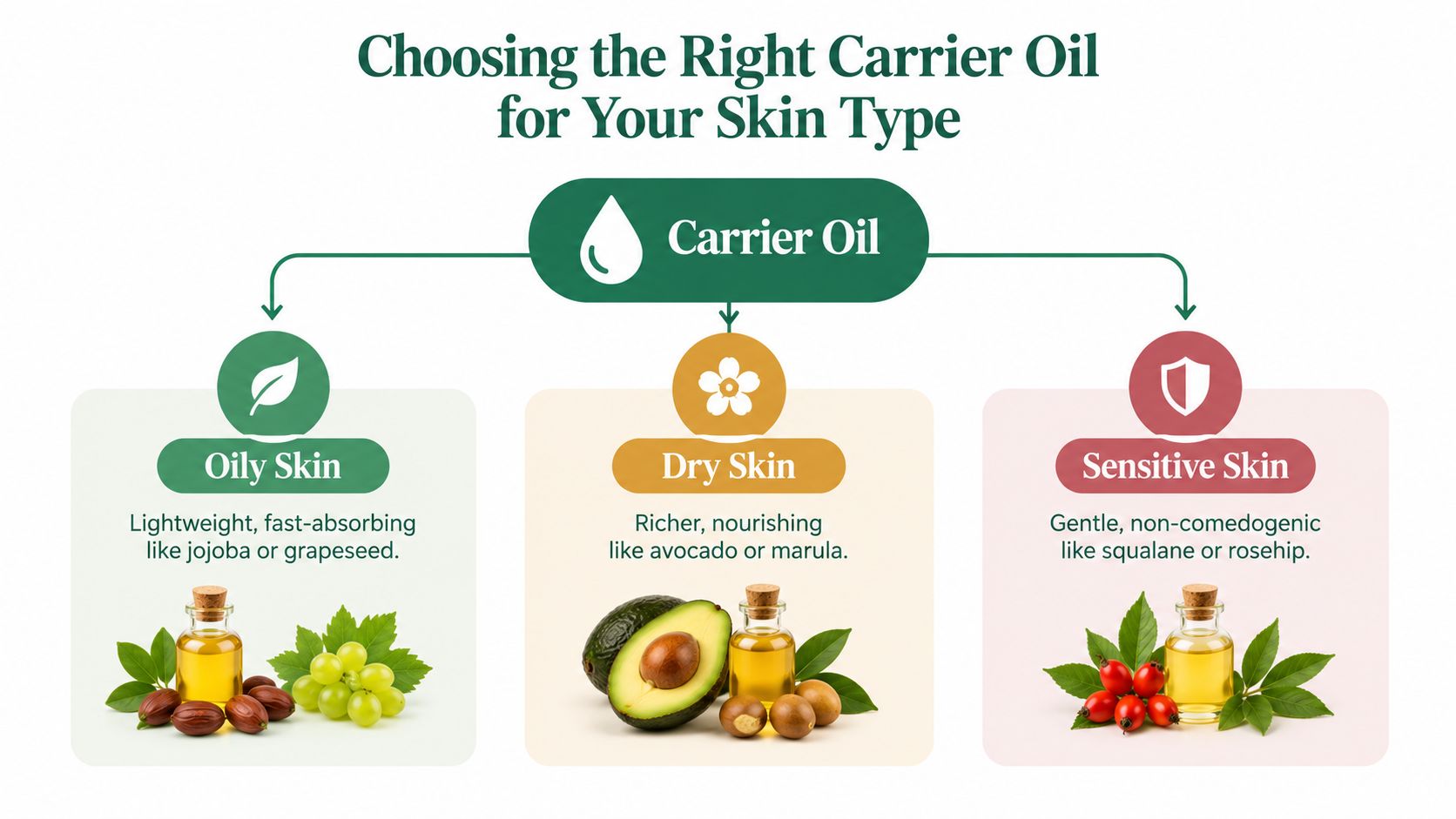
Instead of treating every botanical as a guaranteed match, use familiar carrier names to organize your shortlist.
| Your priority | Carriers to compare | What to assess in the finished formula |
|---|---|---|
| A less oily-feeling finish | Grapeseed, rosehip, hempseed | Spread, residue, and comfort |
| A richer evening experience | Avocado, olive, argan | Whether the texture feels pleasant rather than excessive |
| A simpler conditioning step | Jojoba, squalane, sweet almond | Ingredient-list simplicity and personal tolerance |
These are shopping comparisons, not a clinical ranking. Avoid assuming that an oil's advertised fatty-acid profile predicts exactly how it will feel on your face. Ask the manufacturer for formulation details if that profile is central to the sales claim.
Jojoba is often marketed through comparisons with the skin's own oils, while squalane appears in products positioned as lightweight. Those descriptions can help you select samples, but neither replaces trying the finished product cautiously.
A carrier and a fragrant essential oil aren't interchangeable shopping categories. When reading a blend, separate the base oils from ingredients added mainly for scent or another specialized purpose.
For a closer look at that distinction, consult this guide to essential oils in skincare. Use it to sharpen your label questions rather than to build a homemade vitamin blend.
This video can accompany your comparison of oil-based skincare options.
Shopping rule: Choose the texture you can use comfortably, not the botanical with the most appealing story.
A natural label doesn't establish that coconut oil, rosehip, or any other carrier suits everyone. Likewise, don't interpret a non-comedogenic claim as a personal guarantee. If your skin is easily unsettled by new products, prioritize a short shortlist, clear directions, and cautious introduction over a supposedly perfect oil category.
Two bottles can list the same vitamin and still offer very different levels of formulation transparency. A worthwhile manufacturer should explain more than the ingredient's reputation. You want to understand what's present, why it's there, and how its quality is maintained.
The following visual is a quick shopping aid, but some shorthand deserves qualification. Cold-pressed, unrefined, and naturally scented aren't universal quality requirements, and amber glass alone doesn't establish ingredient stability.
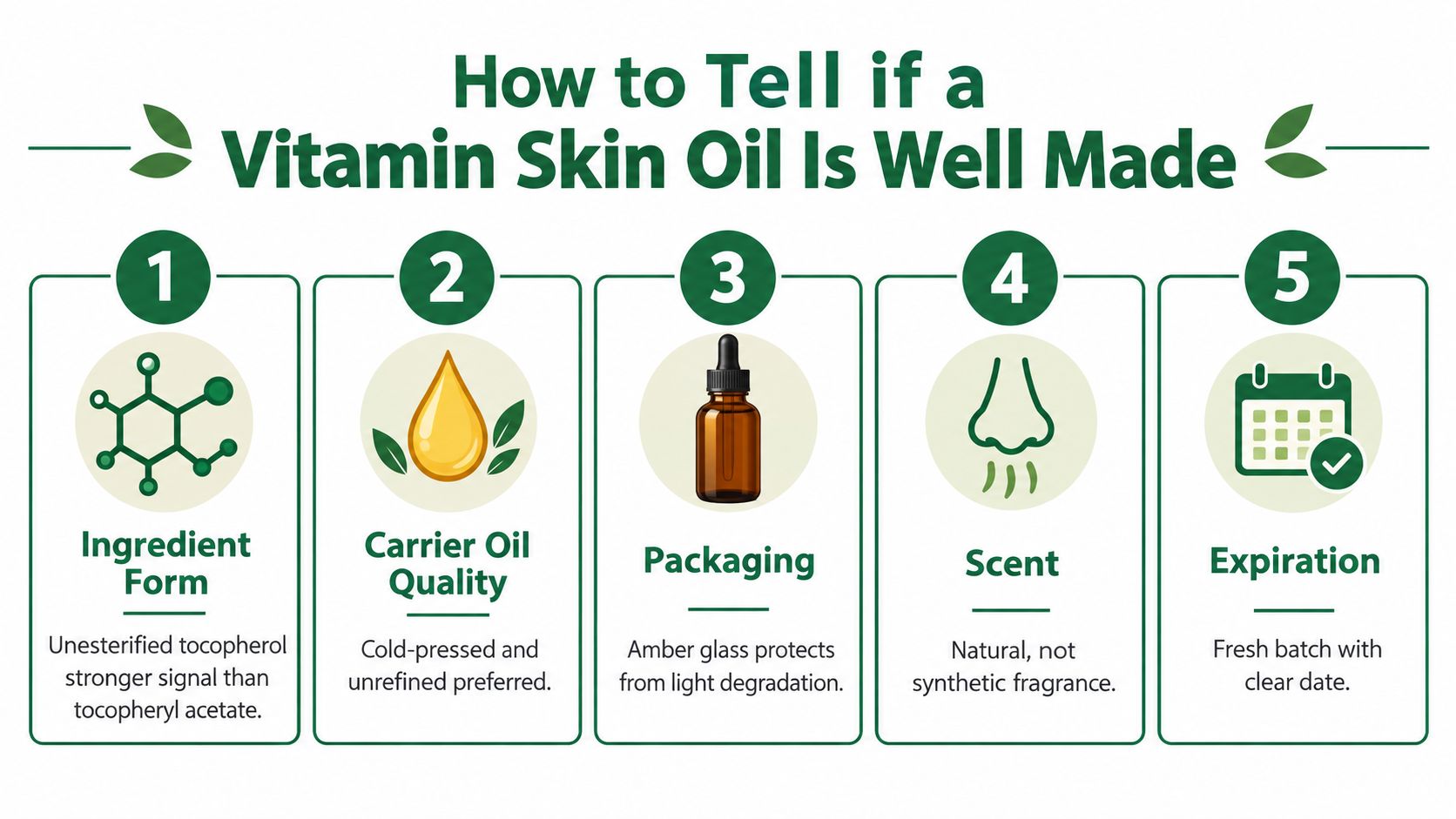
Begin with the exact vitamin form. The distinction between tocopherol and tocopheryl acetate has already shown why a shared vitamin name doesn't establish equivalent evidence. With retinol or a vitamin C derivative, look for similarly specific identification.
Next, ask what a stated concentration describes. Does the percentage refer to the vitamin itself or a supplier blend containing it? A large number without a clear explanation creates more uncertainty, not more confidence.
For another consumer perspective on cosmetic claims, ProMD Health Ashburn med spa advice can complement your label review. Keep the decisive questions focused on the specific product rather than broad natural-skincare positioning.
Packaging is especially important for retinol. Retinol can remain stable for more than six months under the reported conditions of manufacture in an inert atmosphere and storage below 20°C in aluminum tubes; ordinary cosmetic packaging may leave little active retinol by application, according to the dermatology literature review on retinol stability.
That finding isn't a universal shelf-life promise. It shows why a manufacturer needs stability evidence for its own formula and container.
Apply these checkpoints before buying:
Third-party certifications can be useful, but ask what each one verifies. Certification of a farm doesn't, by itself, prove the cosmetic performance of a finished bottle.
A quality claim becomes more useful when the manufacturer can show what it checked.
Vertical integration can give a producer direct oversight of farming, processing, and manufacture. It doesn't automatically establish better results than every competitor. The practical question remains: Can this brand show where the raw material came from and how it was processed?
You don't need to make your evening routine more elaborate to give a vitamin skin oil a fair trial. Keep familiar products in place, add the new oil cautiously, and follow its directions. That makes it easier to tell whether the product suits you.
Begin with a gentle cleanse and avoid unnecessary rubbing. For a simple conditioning oil, application to slightly damp skin may be a practical option if the label allows it. A retinol-containing product may have different instructions, so don't transfer directions from one bottle to another.
A cautious application sequence is more useful than a universal drop count.
The earlier vitamin C review also flags sensitivity concerns with vitamin ingredients, including reports involving vitamin E acetate. That's another reason not to mistake familiar or natural for universally well tolerated.
A small-area check can help you notice an immediate problem, but it isn't a guarantee that your skin will always accept the product. Introduce retinol gradually rather than making nightly use the starting requirement.
For a straightforward oil routine, water-based products generally belong earlier, but the finished formula's instructions should decide the order. Some oils fit before moisturizer; others are intended as the final conditioning layer.
Avoid mixing a vitamin oil directly into other concentrated skincare products unless the manufacturer expressly recommends it. Keeping products separate also makes it easier to identify which addition doesn't suit you.
Beverly Wilshire Aesthetics offers a resource to help you find your mature skin regimen. For a broader approach to keeping a routine manageable, explore this natural skincare guide.
Evening habit: Keep the routine simple enough that you can notice what changes.
Judge comfort separately from longer-term appearance goals. A pleasant finish doesn't prove the vitamin has delivered a measured clinical effect, and the retinol evidence discussed earlier involved sustained use of a defined formulation. Don't adopt an unsupported countdown for smoother texture or more even-looking tone.
A convincing product description often begins with a real ingredient property and ends with a much bigger promise. The shopper's job is to notice that jump. Supportive skincare benefits and dramatic appearance claims aren't the same thing.
Use the evidence discussed earlier to challenge these familiar assumptions without dismissing vitamin oils altogether.
The sunscreen question deserves particular clarity. Vitamin E may absorb some UVB, but it doesn't provide adequate UVA protection and mustn't replace broad-spectrum sunscreen, as explained in Cleveland Clinic's guidance on vitamin E for skin health.
That guidance also describes reduced moisture loss as vitamin E's most reliable practical benefit, with generally subtle effects. A modest, comfortable result can still be worthwhile when that's what you bought the product for.
Keep your oil cool, dark, and tightly closed, following the manufacturer's specific storage instructions. A shelf exposed to sunlight or a warm, steamy bathroom isn't a sensible default for a formula whose ingredients may be vulnerable to heat and light.
Use the brand's stated period after opening. If you can't remember when you opened it, note the date on the container rather than estimating later.
Changes in smell, appearance, or texture are reasons to question the product's condition, not signs that it has become stronger. Contact the manufacturer if you're unsure, and don't rely on appearance alone to confirm vitamin activity.
The decision framework is straightforward: choose the vitamin by your goal, the finished texture by your preferences, and the manufacturer by its transparency. Store the bottle according to its directions, then resist the urge to interpret every marketing adjective as evidence.
A topical routine is one part of everyday wellness, not a complete explanation for how your skin looks or feels. Consider it alongside ordinary habits such as hydration, balanced nutrition, and adequate rest. Don't ask a facial oil to stand in for those habits.
Keep the distinction between external products and dietary supplements clear. A supplement can be considered for normal wellness support, but topical vitamin research doesn't establish that an oral aloe product delivers the same appearance outcomes. Each product needs evidence appropriate to its own formula, use, and claims.
If you're considering adding an aloe-based supplement, a qualified practitioner can help you assess whether it fits your needs. Read its ingredient list and serving directions independently of your facial oil's instructions.
Useful questions include:
For related reading on appearance-focused habits, explore this guide to supporting skin elasticity. Keep your expectations grounded in the distinction between general wellness information and evidence for a particular product.
Statements such as supports healthy skin function or helps maintain normal skin appearance describe normal-function goals. They aren't automatic proof of a benefit, and choosing softer wording doesn't remove a manufacturer's responsibility to substantiate it.
FDA guidance on dietary supplement structure/function claims requires these statements to be truthful and not misleading. A sensible inside-and-outside routine therefore combines realistic expectations, clear product directions, and professional input when appropriate.
These statements have not been evaluated by the Food and Drug Administration. This product is not intended to diagnose, treat, cure, or prevent any disease.
AloeCure offers organic aloe juice and supplements from a vertically integrated operation that farms its aloe, processes it, and produces its own products, providing a traceable quality approach to complement a thoughtful vitamin skin oil routine. Visit AloeCure to compare product pages, review shipping options and the 90-day money-back guarantee, or choose Subscribe & Save for 20% off with flexible delivery.
Comments will be approved before showing up.