Your Cart is Empty


Staring at the ceiling as another minute ticks by is a feeling most of us know all too well. Learning how to fall asleep naturally isn’t about finding a single magic trick. It's about building a solid foundation of simple, practical habits that work with your body’s natural rhythms, not against them.
Tossing and turning is more than just a nightly frustration; it's a huge issue. If you’re struggling, you're definitely not alone. The National Sleep Foundation found that nearly 4 in 10 U.S. adults struggle to fall asleep at least three nights a week. The good news? Those who prioritize simple sleep habits report feeling much better about their lives overall.
This guide is about more than just temporary fixes. We’re going to look at the whole picture—the deep connection between your daily habits, your mental state, and the quality of your rest. For instance, something as simple as supporting digestive comfort in the evening is an often-overlooked but critical piece of the puzzle for an uninterrupted night.
Focusing on just one thing, like wearing a sleep mask, is like trying to fill a leaky bucket. A real, lasting solution needs to be much broader. It means looking at:
Mindset: Learning simple ways to quiet a racing mind.
Environment: Turning your bedroom into a true sanctuary for rest.
Routine: Creating consistent rituals that signal to your body it's time to wind down.
Lifestyle: Making small, conscious choices during the day that set you up for success at night.
We believe in this complete picture of wellness. It’s the same philosophy we apply to our own process, from farming our aloe to bottling the final product. We are fully vertically integrated—we farm it, process it, and bottle it ourselves to ensure the highest quality support for your body’s natural functions.
By addressing the root causes of restlessness instead of just the symptoms, you can build a foundation for consistently great sleep. It's all about working in harmony with your body.
Ready to start your journey? You can dive deeper with this comprehensive guide on how to sleep better at night. The sections that follow will give you actionable steps to build your own personal sleep toolkit. You have the power to transform your nights, and it all starts with the simple, intentional choices you make tonight.
Consistency is everything when you're trying to sleep better. Think of your pre-sleep routine less like a chore and more like a gentle, reliable signal you send to your brain and body that the day is officially winding down.
This personalized ritual is your chance to consciously shift gears. You’re moving from the high-alert status of a busy day to a calmer, quieter mode, creating a necessary buffer zone between your active life and your resting life.
If there’s one habit that can make a massive difference, it’s creating a "digital sunset." This simply means putting away all your screens—phones, tablets, laptops, and TVs—at least 60 to 90 minutes before bedtime.
Why? The blue light blasting from these devices can interfere with your body's natural production of melatonin, the hormone that manages your sleep-wake cycles. By dimming the lights and stepping away from the screen glow, you let your internal clock do its job properly.
This isn't about punishment. It's an invitation to swap scrolling for something far more soothing that actively prepares you for a night of deep, restorative sleep.
Your wind-down routine should be something you genuinely look forward to. The trick is to find a few low-key activities that help you feel relaxed and centered. Don't be afraid to experiment to see what clicks.
Here are a few ideas to get you started:
Journaling: Spend 10-15 minutes writing. Jot down your thoughts, get your worries out on paper, or list three things you were grateful for today. It's a great way to offload a racing mind.
Light Reading: Grab a real, physical book (not an e-reader, to dodge that blue light). Pick something that’s engaging but not a heart-pounding thriller.
Listening to Calming Sounds: Put on a playlist of ambient music, nature sounds, or even a quiet podcast. This can help mask distracting household noises and guide your mind toward peace.
Gentle Stretching: A few simple, slow stretches can release the physical tension you've built up all day. Focus on deep, steady breathing as you move.
To help you get started, here is a simple checklist of activities you can mix and match to find what works for you. Try picking three or four to do every night.
Build a consistent and effective pre-sleep routine by choosing 3-4 activities to practice nightly.
| Activity | Recommended Timing (Before Bed) | Why It Helps |
|---|---|---|
| Dim Household Lights | 1-2 Hours | Signals to your brain it's time to increase melatonin production. |
| "Digital Sunset" (No Screens) | 60-90 Minutes | Supports melatonin production and helps calm the mind. |
| Take a Warm Bath or Shower | 60-90 Minutes | The subsequent drop in body temperature helps trigger sleepiness. |
| Enjoy a Warm, Caffeine-Free Drink | 30-60 Minutes | Creates a comforting ritual and can have soothing properties. |
| Read a Physical Book | 30-60 Minutes | A relaxing, screen-free way to disengage from daily stressors. |
| Listen to Calming Music/Podcast | 15-30 Minutes | Lowers heart rate and helps quiet a racing mind. |
| Journal or Make a To-Do List | 10-15 Minutes | Offloads worries and organizes thoughts so you don't ruminate in bed. |
| Practice Gentle Stretching | 10-15 Minutes | Releases physical tension held in the muscles from the day. |
Remember, this is about finding what brings you from a state of stress to tranquility. There's no one-size-fits-all answer, so play around with the options until it feels right.
A warm, caffeine-free drink can be a wonderfully comforting anchor for your nightly routine. The simple act of sipping something warm is inherently relaxing and becomes another powerful cue that bedtime is near.
Of course, what you drink matters. You want something that not only tastes good but also supports your body's needs for the evening. Many people love herbal teas like chamomile or peppermint. For those looking for other options, our guide on melatonin alternatives for sleep has some great ideas.
Incorporating a gentle drink like our AloeCure Pure Aloe Vera Juice can be a fantastic addition. It provides that comforting element while also supporting evening digestive comfort—an often-overlooked factor for an uninterrupted night. Because we are fully vertically integrated, from farming our own aloe to bottling it, you can trust the purity and quality of what you're putting into your body as you prepare for rest.
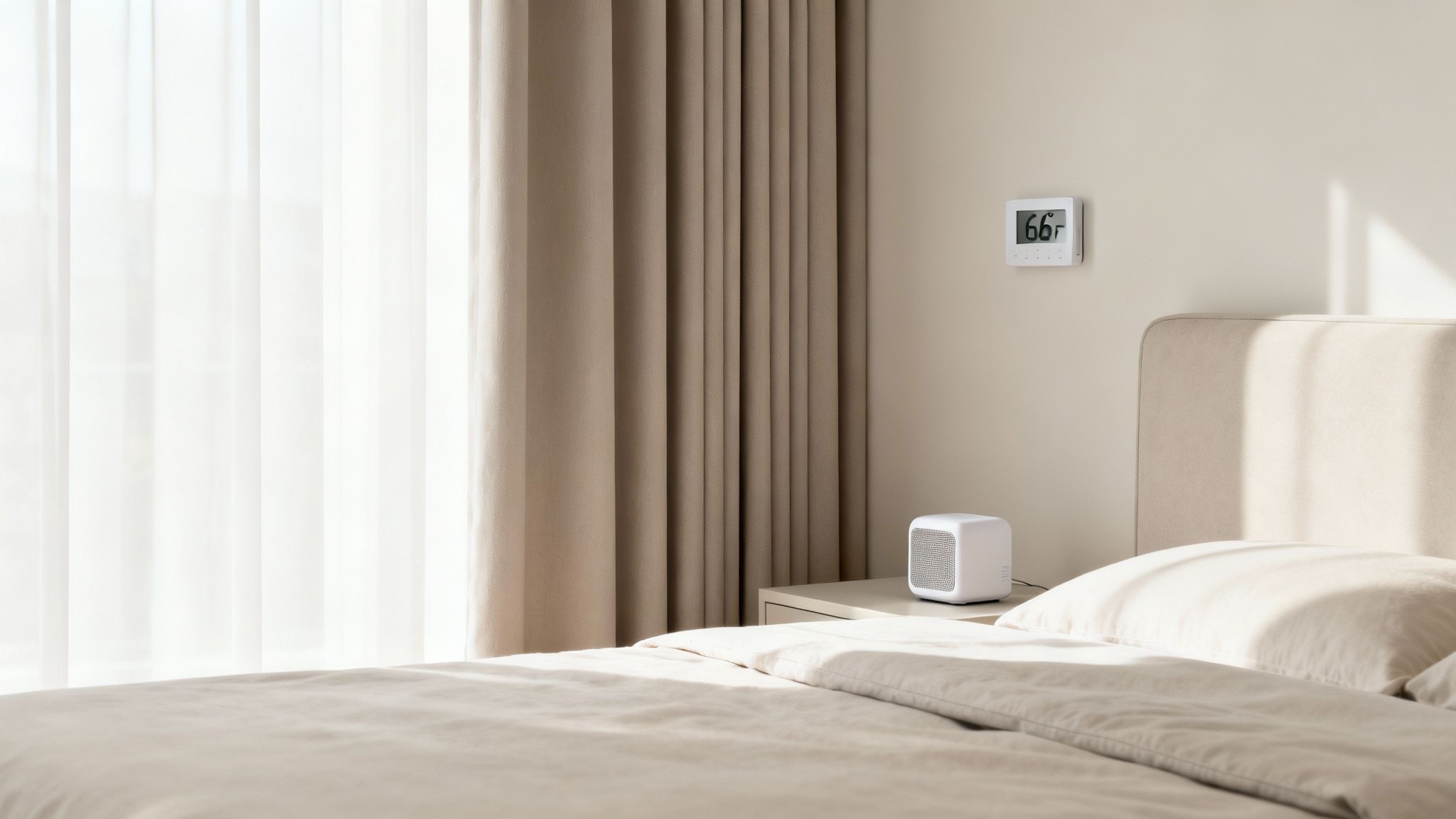
The path to falling asleep naturally often circles right back to your own bedroom. This space should be a true sanctuary for rest, but it’s amazing how often it's filled with subtle disruptions that can chip away at your sleep quality without you even realizing it.
When you take control of your sleep environment, you're sending powerful, non-verbal cues to your body that it's time to power down. We'll zero in on the three big pillars of an ideal sleep space: light, temperature, and sound. Even small, deliberate tweaks in these areas can make a world of difference.
Your body's internal clock, known as its circadian rhythm, is incredibly sensitive to light. Any light exposure at night—even the tiny glow from a charging phone or a crack of light from a streetlight—can interfere with melatonin production. Melatonin is the hormone that basically tells your body, "Hey, it's time to sleep now." The goal here is simple: make your room as dark as humanly possible.
Here are a few practical ways to do it:
Invest in blackout curtains or shades. Honestly, this is one of the single most effective upgrades you can make for blocking out pesky external light.
Cover up or remove electronic lights. A small piece of electrical tape is your best friend here. Use it to cover the indicator lights on your TV, power strips, and chargers. If your alarm clock is a beacon in the night, turn it to face the wall or swap it for one with a dimmable display.
Try a comfortable sleep mask. A good, contoured sleep mask can be a total game-changer, creating your own personal blackout zone no matter what's going on around you.
Ever find yourself tossing and turning on a hot summer night? There's a biological reason for that. Your body's core temperature actually needs to drop a bit to kick off the sleep process and keep you snoozing soundly. A cool room helps this happen naturally.
For most people, the sweet spot for sleep is between 60 and 67 degrees Fahrenheit (15-19°C). This might feel a little chilly when you first get into bed, but it's what encourages your body to sink into the deeper, more restorative stages of sleep.
A cool sleeping environment is one of the most critical—and most often overlooked—factors for great rest. Setting your thermostat right works with your body's biology, not against it.
Play around within this range to discover what feels best for you. A programmable thermostat can be a huge help, letting you automatically cool the room down an hour or so before you plan to turn in.
A sudden, unexpected noise can easily yank you right out of a light stage of sleep. While you can't silence a neighbor's dog or a passing siren, you can create a consistent, soothing soundscape that helps mask those jarring disruptions.
This is where a steady, ambient noise becomes your secret weapon. It essentially builds a "sonic wall," making sudden noises like a car horn or a slamming door much less likely to startle you awake.
Here are some effective ways to manage the noise in your bedroom:
Use a white noise machine. These little devices are fantastic for masking abrupt noises because they produce a consistent sound across all hearable frequencies.
Turn on a fan. A simple fan does double duty, providing a steady hum that serves a similar purpose while also keeping the air circulating.
Try a sound app. Plenty of smartphone apps offer everything from rainfall and ocean waves to simple white or pink noise. Just be sure to turn your phone face down so the screen stays dark.
By fine-tuning these three elements—light, temperature, and sound—you can transform your bedroom from just a room you sleep in to an environment actively designed to promote deep, uninterrupted rest. These changes support your body’s natural desire to sleep, making it much easier to fall asleep naturally and stay that way all night long.
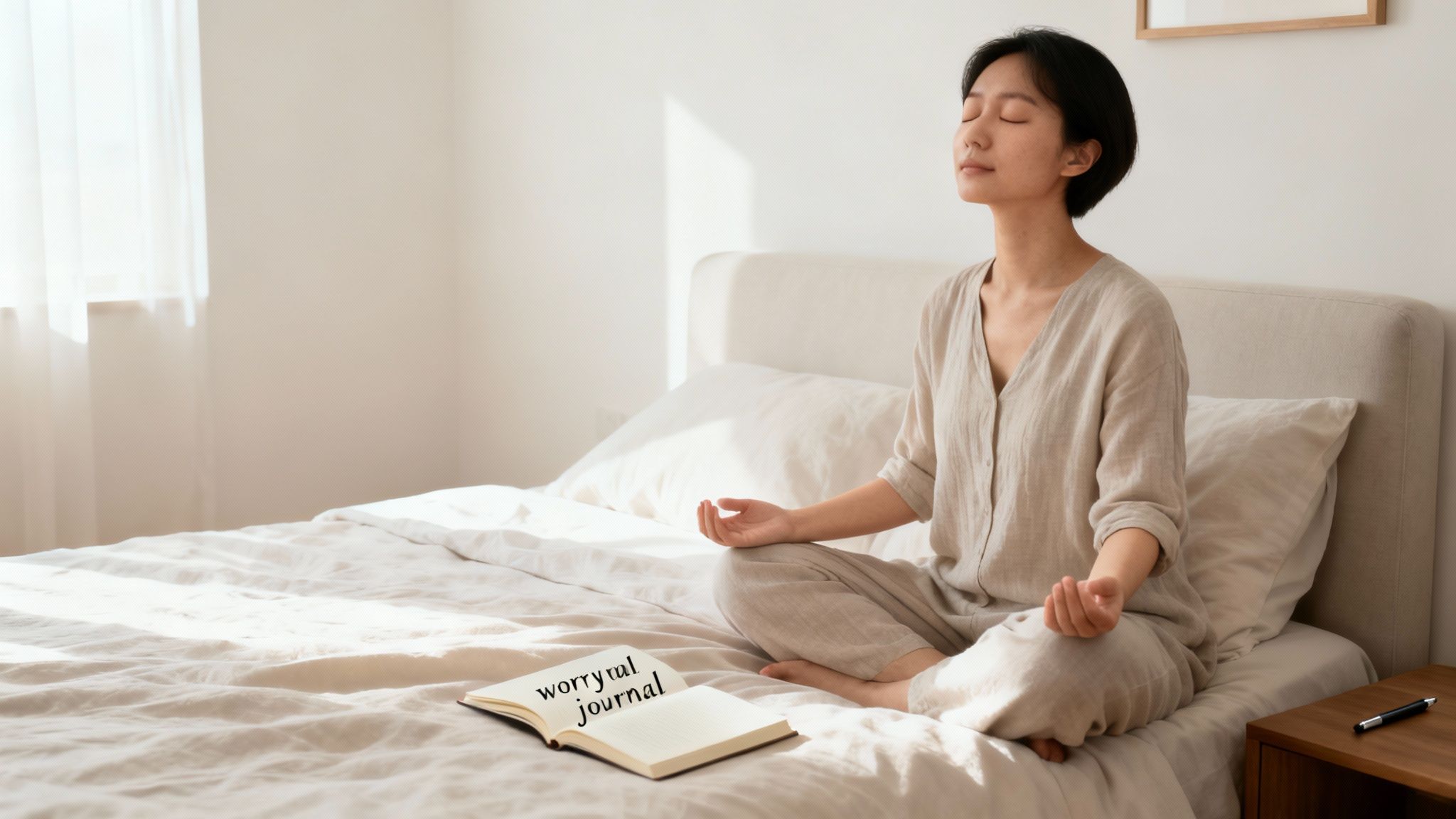
So you’ve perfected your bedroom environment and nailed down a solid wind-down routine, but your mind just won’t switch off. Sound familiar? More often than not, the real culprit keeping you awake is a racing mind—that endless loop of tomorrow’s to-do list, conversations you keep replaying, or worries you can’t control.
To fall asleep naturally, you need a few tools to gently guide your brain from high alert to quiet calm. The idea isn't to force your thoughts to stop (which is nearly impossible). It's about giving your mind something else—something more peaceful—to focus on.
These techniques are practical skills you can learn and use anywhere, whether you're trying to drift off at 10 PM or find yourself staring at the ceiling at 3 AM.
One of the fastest ways to pump the brakes on your body’s stress response is to take control of your breath. The 4-7-8 breathing technique is a deceptively simple exercise that can have a powerful relaxing effect.
It works by supporting your parasympathetic nervous system—the part of you responsible for “rest and digest.” Here’s how you do it:
Place the tip of your tongue against the ridge of tissue right behind your upper front teeth. Keep it there for the whole exercise.
Exhale completely through your mouth with a "whoosh" sound.
Close your mouth and inhale quietly through your nose for a count of four.
Hold your breath for a count of seven.
Exhale completely through your mouth, making that "whoosh" sound again, for a count of eight.
That’s one full breath cycle. Just repeat it three more times for a total of four breaths. It might feel a bit strange at first, but with practice, it becomes a go-to tool for slowing a pounding heart and quieting a busy mind.
A racing mind and a tense body often go hand-in-hand. You might be clenching your jaw or tightening your shoulders without even knowing it. Progressive Muscle Relaxation (PMR) is a fantastic technique that teaches you to notice and release this hidden tension.
The process is simple: you systematically tense a specific muscle group, hold it for a few seconds, and then let it go completely. This sharp contrast helps you become deeply aware of what true relaxation feels like.
How to Practice PMR in Bed:
Lying on your back, start with your toes. Curl them up tightly for five seconds, then release. Feel the warmth as the tension drains away. Slowly work your way up your body, tensing and relaxing each muscle group: your calves, thighs, glutes, abdomen, arms, and finally, your face and jaw.
This exercise doesn't just relax your body; it gives your mind a specific, grounding task to focus on instead of runaway thoughts.
Sometimes, the best way to get thoughts out of your head is to literally get them out. Keeping a "worry journal" on your nightstand gives you a dedicated space to unload anxieties before they get a chance to ruin your sleep.
Just set aside five or ten minutes before bed to scribble down whatever is on your mind. It could be a to-do list for tomorrow, a problem you're wrestling with, or just a vague feeling of unease.
The simple act of writing it down acknowledges the thought and essentially "schedules" it for the next day. This gives your mind permission to finally let go for the night. You've captured it on paper, so you no longer need to keep it on repeat in your head. If occasional feelings of anxiousness are a barrier to your sleep, exploring practical strategies to cope with anxiety can offer more support for calmer days and peaceful nights.

Great sleep doesn't just happen when your head hits the pillow. It's actually the result of dozens of small choices you make all day long, starting from the moment you wake up. Learning how to fall asleep naturally means understanding that your daytime habits are constantly sending signals to your body, preparing it for either alertness or rest.
Think of your body as having an internal 24-hour clock, known as your circadian rhythm. This clock loves consistency. When your daily routine is predictable and synced up with natural light and dark cycles, that clock works beautifully, making it much easier to drift off at night. But when your habits are all over the place, it can throw that internal timer into chaos, leaving you feeling wired and restless at bedtime.
Your very first actions of the day can have the biggest impact on your night. One of the most powerful ways to set your internal clock right is to get some natural sunlight shortly after waking up.
Getting just 20 to 30 minutes of morning sun sends a clear message to your brain to stop producing melatonin (the sleep hormone) and start making hormones that promote alertness and a positive mood.
This simple act does more than just wake you up; it sets a precise timer for later in the day. Consistent sun exposure helps regulate your circadian rhythms, which can shorten the time it takes to fall asleep by as much as 30%. You can learn more about how light impacts sleep from the folks at World Sleep Day.
Just opening the blinds while you drink your coffee or taking a quick walk outside is enough. This small habit reinforces the natural cycle of wakefulness and sleepiness, making your body much more receptive to rest in the evening.
Morning light also helps your body produce serotonin, a neurotransmitter that contributes to feelings of well-being. Later, as darkness falls, your body naturally converts this serotonin into melatonin—the very hormone you need to feel sleepy.
Regular physical activity is fantastic for promoting deeper, more restorative sleep. It helps manage stress and creates a healthy physical need for rest. However, when you exercise can be just as important as if you exercise.
For most of us, a morning or afternoon workout is perfect. This raises your core body temperature, and the gradual drop a few hours later helps trigger sleepiness, signaling that it’s time to wind down.
But what about evening workouts? If a late-night gym session is your only option, that’s okay—moving your body is always a good thing. Just be mindful of the intensity. A really high-intensity workout too close to bedtime might be too stimulating for some people. If you find yourself amped up afterward, you might consider switching to more relaxing activities like yoga or gentle stretching in the evening.
What and when you eat plays a huge role in your ability to sleep soundly. Your digestive system is deeply connected to your sleep cycles, and giving it the right support is a key part of learning how to fall asleep naturally. A large, heavy meal right before bed forces your digestive system to work overtime when it should be resting.
To support digestive comfort, try to finish your last big meal at least two to three hours before you plan to lie down. If you get hungry later on, a light, simple snack is a much better choice.
For those looking for a little extra support, incorporating gentle supplements can be a helpful step. Products designed to work with your body's natural processes can complement your healthy habits.
For Sleep Cycle Support: Our Melatonin + Collagen Sleep Capsules are formulated to support the body’s natural sleep cycle, promoting a sense of calm as you prepare for bed.
For Digestive Comfort: Our Pre+Probiotic & Digestive Enzyme Capsules help maintain a healthy balance in your digestive system, supporting comfort throughout the night.
At AloeCure, we are committed to quality you can feel. As a fully vertically integrated company, we control every step of the process—from farming our own organic aloe to processing it without harsh chemicals to producing the final product. This ensures you receive high-quality, plant-based support for your body’s natural functions. For a deeper dive into optimizing your daily habits, check out our guide on how to improve sleep quality naturally.
Whenever you start a new wellness journey, a few questions are bound to pop up. To help you feel confident as you build a better sleep routine, we’ve gathered answers to some of the most common questions we hear.
Think of this as a quick reference to reinforce what you’ve learned and give you that extra bit of clarity when you need it.
This is the big one, isn't it? While some changes, like making your room pitch-black or doing a quick breathing exercise, can help you feel calmer right away, resetting your body's internal clock takes a little more time. It’s all about consistency.
Most people start to notice significant, lasting improvements within one to four weeks of sticking with their new habits. Remember, you're building a foundation for long-term health, not just looking for a quick fix. Patience is key.
Yes, but you have to be smart about it. A short “power nap” of about 20-30 minutes in the early afternoon can actually do wonders for your alertness and mood without messing up your nighttime sleep.
The danger lies in long naps or napping too late in the day. This can drain your "sleep drive," which is that natural feeling of tiredness you need to fall asleep at night. If you’re having trouble falling asleep, try cutting back on your naps and see if that helps build up more sleepiness for bedtime.
First things first: resist the urge to check the clock or your phone. The moment you see it’s 3 AM, your brain starts racing with stressful thoughts about how little sleep you’re getting, which only makes things worse.
Instead, try a simple relaxation technique, like the 4-7-8 breathing method. If you’re still wide awake after 20 minutes or so, it’s best to get out of bed. Go to another room with dim lighting and do something calm—read a book (a real one, not on a screen!), listen to soft music, or just sit quietly until you feel sleepy again.
This simple trick helps your brain maintain the strong connection that your bed is for sleeping, not for tossing and turning.
If you’ve been trying these natural techniques consistently for several weeks and still aren't seeing any real improvement, it might be time to get some expert guidance. You should also see a healthcare professional if poor sleep is seriously impacting your daily life, mood, or energy levels.
A professional can help figure out if there are any underlying issues and work with you on a more personalized plan.
And for those who are curious about common over-the-counter options, it’s always wise to be fully informed. It's a good idea to understand all aspects, including potential drawbacks, which you can do by reading up on the possible side effects of melatonin.
At AloeCure, we are dedicated to supporting your wellness journey with high-quality, plant-based products. From our organic farms to your home, we ensure purity and potency in every bottle. Explore our full range of products and sign up for 20% off your subscription at https://aloecure.com.
These statements have not been evaluated by the Food and Drug Administration. This product is not intended to diagnose, treat, cure, or prevent any disease.
Comments will be approved before showing up.