Your Cart is Empty

The best-supported benefit is help maintaining hydrated, soft-feeling skin with repeated evening use of a well-built cream, not a visible change by morning. The numbers are modest and specific: after one application, formulas with 0.25% and 0.50% aloe vera extract raised water content in the outer skin layer while 0.10% did not, and after two weeks of repeated use all three levels did.
So why does the jar in your bathroom cabinet suggest otherwise? Because hydration is a quiet, measurable thing, and a promise of transformation sells better. Learning to read the difference changes how you shop, how you apply the cream, and what you expect to see in the mirror two weeks in.
A night cream is a leave-on moisturizer you wear for six or seven hours while you sleep, which is why the format matters as much as the plant on the label. Think of your outer skin as a sponge under a light blanket. Aloe helps that layer hold water, humectants such as glycerin pull water toward it, and lipids or film-formers act as the blanket that slows water from leaving. Get the blanket wrong and the sponge dries out overnight, no matter how much aloe went in.
That picture sets honest expectations. The best-supported aloe vera night cream benefits are hydration and a softer feel built up over several evenings, not a new face by sunrise.
A controlled cosmetic-formulation study compared creams with 0.10%, 0.25%, and 0.50% aloe vera extract against a plain base cream. After a single application, only the 0.25% and 0.50% versions raised water content in the stratum corneum, the outermost skin layer (the cosmetic formulation study indexed on PubMed). The weakest version produced no measurable change on night one.
That result answers a question most shoppers never think to ask. Concentration changes the outcome, so a cream that lists aloe somewhere in a long ingredient deck may behave like the 0.10% formula: pleasant on the skin, with no measurable water gain after a single use.
Repetition rearranges the picture. After two weeks of repeated use, all three aloe-containing formulas produced higher stratum-corneum water content than the control, including the weakest one.
A single night rewards a higher percentage. Steady use levels the field. That's the reason to judge a cream at the two-week mark rather than on the first morning.
Independent hydration testing in 59 volunteers came back mixed across short and longer-term assessments, with a water placebo performing better than aloe in one comparison. That finding is the clearest argument for describing aloe as a moisturizing ingredient rather than a guaranteed transformation.
Aloe performs best next to barrier lipids, not instead of them. A small double-blind randomized trial of 30 batik workers tested a cream with 2% aloe vera plus ceramides. Transepidermal water loss, the measure of water escaping through the skin, dropped significantly at two weeks, stratum-corneum hydration rose at two and four weeks, and skin pH shifted significantly at four weeks (the trial report in the Journal of Pakistan Association of Dermatologists).
The limits matter. That cream also carried ceramides and the group was small, so the study can't show aloe alone does that work, and it says nothing about any particular jar on a shelf. It does show the combination is the sensible design.
The useful rule: buy the full formula, not the headline ingredient. Aloe with ceramides, glycerin, or petrolatum is a different product from aloe in a watery gel.
A night cream stays put through hours of stillness, without makeup layered over it or a hand washing it off at lunch. That's why the studies that showed more outer-layer water used repeated applications rather than one swipe, and why the evening is the fair test.
Nothing about sleep makes a weak formula stronger, though. A watery gel in a dry bedroom can evaporate and leave skin feeling tighter by morning, which is a formulation problem rather than a signal to apply more.
Potential aloe vera night cream benefits and realistic windows
| Reader goal | Careful wording | What was measured | Realistic window |
|---|---|---|---|
| Soft moisturized feel | Promotes a soft-feeling complexion | Outer-layer water content rose at 0.25% and 0.50% aloe after one use; 0.10% did not | Several hours on the skin |
| Ongoing hydration support | Helps maintain normal skin moisture | All tested levels, 0.10% to 0.50%, raised outer-layer water after repeated use | About 2 weeks |
| Comfortable nighttime routine | Supports a refreshed nighttime skincare routine | Broad outcome claims are not well defined across trials | Ongoing use only if skin stays comfortable |
| Barrier support with lipids | Helps maintain the skin's normal moisture barrier | A 2% aloe plus ceramide cream in 30 people lowered water loss at 2 weeks | 2 to 4 weeks |
At-home cream and in-clinic care do different jobs, and the good ones stack. If you want deeper resurfacing than a moisturizer can reach, a skin rejuvenation facial in Dubai pairs with a nightly hydration routine instead of replacing it, and the professional appointment works best when your barrier is already comfortable.
If tightness is your main complaint rather than visible flaking, this guide to how aloe vera helps dry skin walks through layering order so the water you add stays where you put it.
Most product pages blur two different things: a feeling on your skin and a change someone measured. They aren't the same, and the gap between them is where disappointment lives.
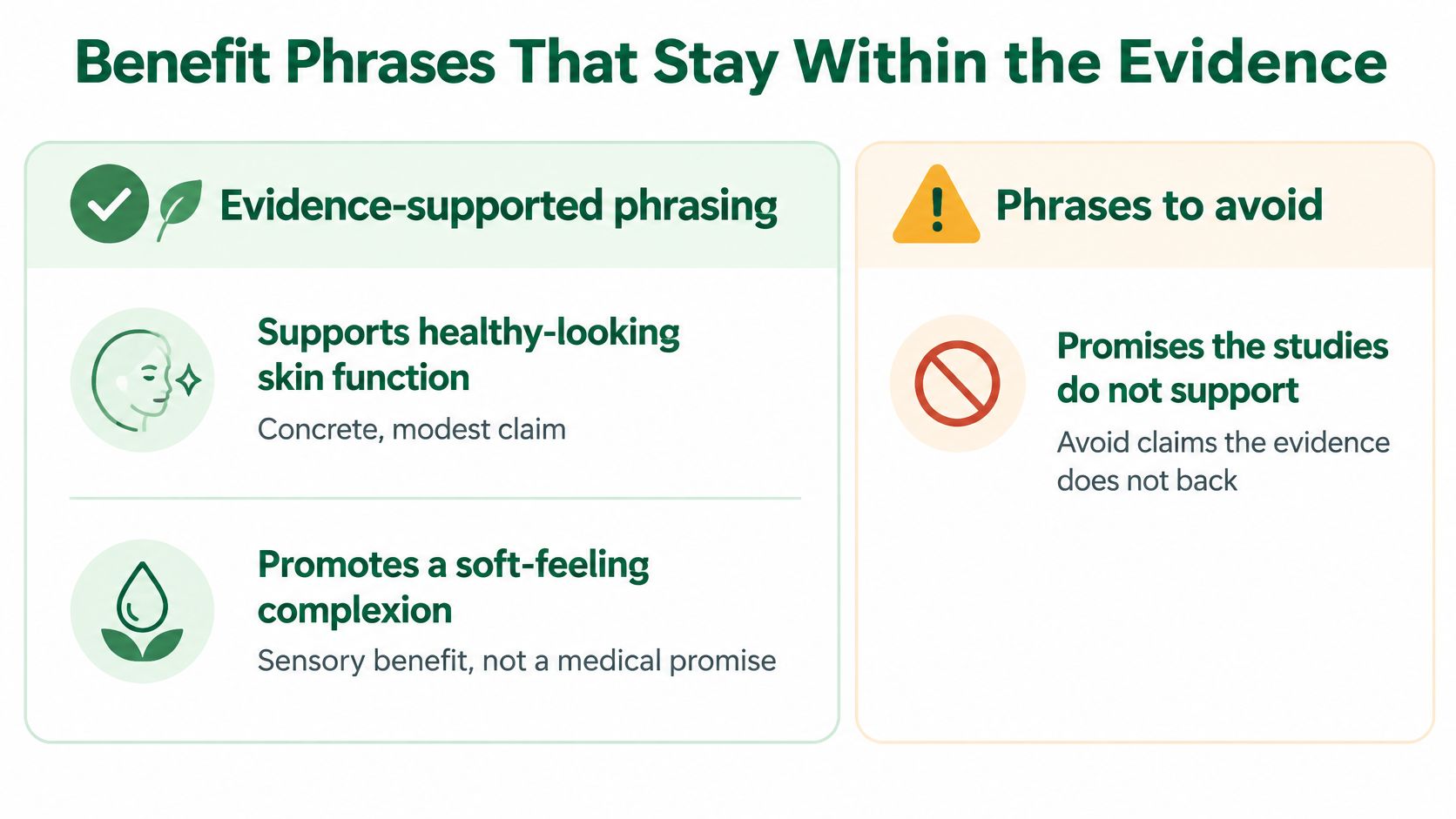
Apply one test to every line you read, including the ones on your own favorite jar: is this describing a sensation, a measured change, or a promise nobody studied?
The broader record backs that restraint. A systematic review covering 10 clinical trials with 803 participants, six randomized controlled trials and four controlled clinical trials, found topical results mixed and concluded that clinical effectiveness was not sufficiently defined (the systematic review on NCBI Bookshelf). It also recorded occasional reversible effects after topical use, including burning and mild itching.
Wording carries legal weight too. The FDA's guidance on cosmetic labeling claims states that cosmetic claims must be truthful and not misleading, and that a product can be legally classified as a drug when its labeling claims it will prevent a condition or affect the structure or function of the body, including the skin. Cosmetics don't need premarket approval and the agency keeps no list of preapproved claims, which places the burden on the seller to substantiate the words.
Write the claim you can defend at two weeks: "helps maintain the skin's normal moisture balance" survives scrutiny. "Look ten years younger" does not.
That leaves plenty of room for honest language: supports healthy-looking skin function, promotes a soft-feeling complexion, helps maintain the skin's normal moisture balance, provides light hydration before bed.
A cool tingle feels like proof the product is working. It isn't. Cooling is a sensation, and it can just as easily be the first signal that your skin isn't happy with something in the formula.
Reactions to topical aloe are documented. Dermatology references describe burning, itching, hives, and allergic skin responses after application, including reactions to raw leaf material and positive patch tests to aloe leaf itself (DermNet's page on aloe vera and the skin). A wider review of herbal monographs reaches a similar place, noting that topical aloe is generally well tolerated while recording burning, itching, and rash in some users (the herbal medicine monograph chapter on NCBI Bookshelf). Favorable is not the same as risk-free.
Raw leaf gel is also not the same as a finished cream. Leaf fluid, fragrance, preservatives, and crowded botanical blends all sit alongside the aloe, and any of them can be the thing your skin objects to.
Extra caution belongs around the eyelids, on skin you've just scrubbed or exfoliated hard, and for anyone who already reacts to plants in the aloe family or to fragranced formulas. A low-humidity bedroom can also leave a watery gel feeling drier by morning, which is a formula issue, not a reason to pile on more.
If a reaction spreads, keeps returning, or doesn't settle, the next step is a qualified skin professional rather than another night of the same cream. For the routine around the test, this guide to natural skin care explains how to layer products without stacking several new ones at once.
Application is where most routines fail. The right amount, in the right order, at the right moment before your pillow, decides whether the cream gets a chance to do its job.
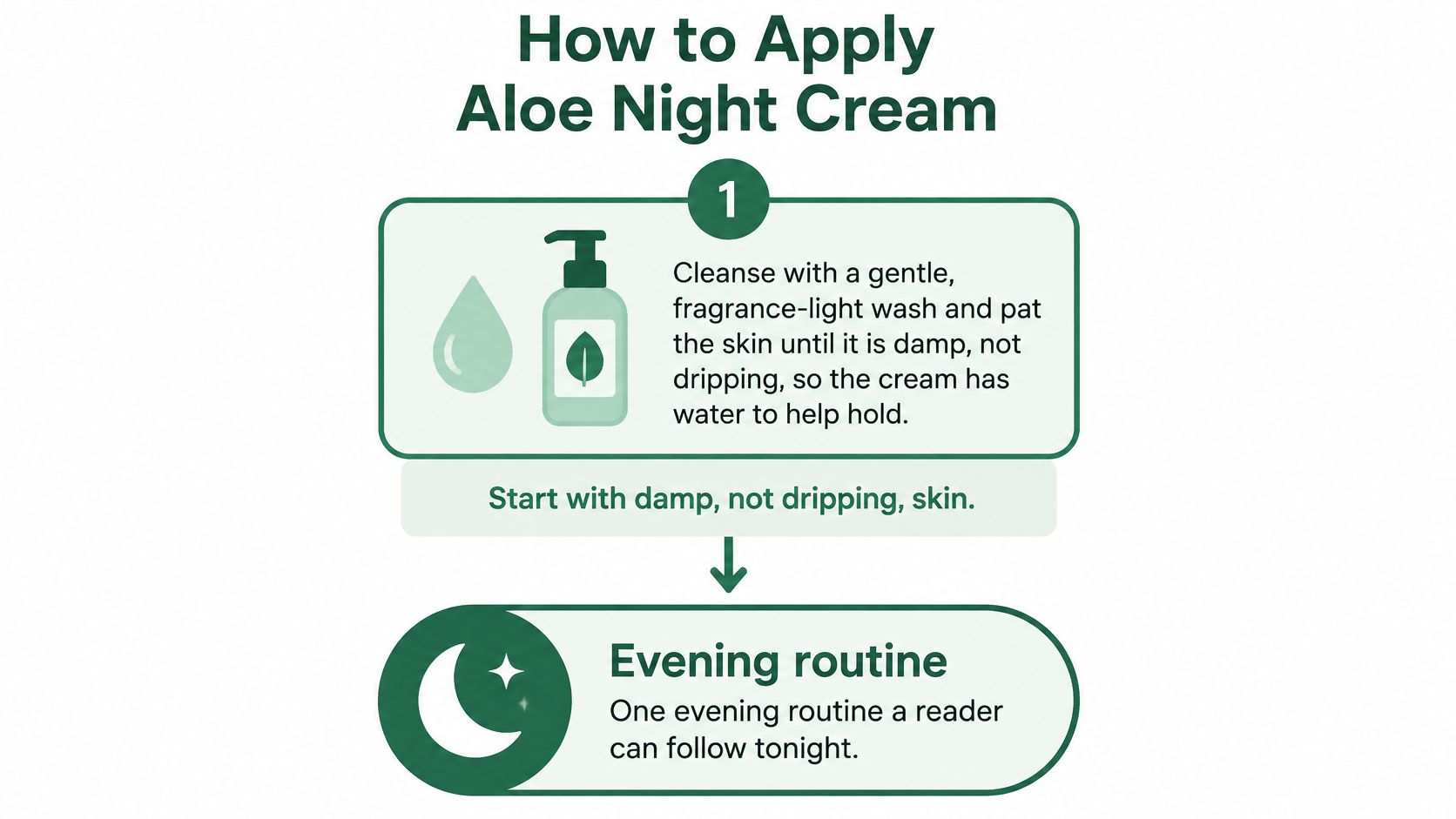
The evening timing fits the evidence. The cream remains in place for roughly six to eight hours, and the studies that showed more outer-layer water used repeated applications rather than a single swipe.
Practical check: at two weeks, ask whether tightness and flaking have eased. At four weeks, ask whether skin still feels comfortably moist by late afternoon. Those are the questions the measurements actually answer.
If you use a gel as a thin nighttime facial mask, keep it sheer. A heavy coat feels tight as the water evaporates in a dry room, which reads as dryness even though you applied more product. Adjust the amount down over oily areas and up slightly on dry cheeks.
For a visual walkthrough of the same sequence, this short demonstration covers the order and the amount.
The leaf drawing on the label tells you nothing about the jar. What matters is which part of the plant went in, how quickly it was handled, and whether anyone independent checked the paperwork.
Slice a leaf and you find three layers. The clear inner gel is the part commonly meant by aloe. The yellow fluid just beneath the rind is a different material entirely, and a face cream shouldn't be relying on it. Whole-leaf products grind everything together, so the question of what was separated, and when, is a real one.
Acemannan, a polysaccharide made in the inner leaf, is often discussed as a marker that distinguishes aloe vera gel from diluted imitations. A label should still tell you the form and the amount used, not only the plant name.
Aloe is plant tissue, and tissue changes after cutting. We grow our own organic aloe, hand-harvest it, and process it on site within 12 hours of harvest using a patented natural process that avoids the chemicals, enzymes, charcoal filtration, and concentrates common in large-scale processing. Our own skin-care line, ALODERMA, is made from that same organic aloe. Farm through processing through finished formula is a quality claim you can trace rather than take on faith.
Label check: a jar should name the aloe form and where it sits in the ingredient list. If water and alcohol come first and aloe trails at the end, you're buying a light gel with aloe as a guest.
USDA organic certification is a verification, not a mood word. The USDA Agricultural Marketing Service organic certification program explains that certification confirms a farm or handling facility complies with USDA organic regulations and permits products to be labeled as organic. A USDA-accredited state, private, or foreign certifying agent carries it out, and for processing facilities inspectors review receiving, processing, and storage areas, assess the operation's Organic System Plan, evaluate hazards and critical control points, and check the procedures designed to prevent contamination or commingling with nonorganic material.
That's the standard behind the certification we hold, and it's why "organic" belongs only on a product whose farm or handler earned it.
The inner gel used in these formulas contains 18 amino acids and vitamins A, B1, B2, B3, B6, C, and E. None of that replaces concentration and full-cream design, but it tells you the aloe was treated as a fresh ingredient rather than a reconstruction from powder. For a deeper look at the raw material itself, this overview of pure aloe gel for skin covers what the clear inner gel does well and where it needs a partner.
Here's the decision in plain terms. If your goal is a soft, moisturized feel and your patch test stayed comfortable, choose a simple inner-leaf gel from a maker that farms and finishes its own aloe, and give it two weeks of evenings before you judge it.
ALODERMA Pure Aloe Vera Gel, from the skin-care line owned alongside AloeCure, is made from fresh certified organic aloe processed within 12 hours of harvest. It's positioned for dry-skin moisturizing and as a nighttime facial mask, and the 300 g bottle is listed at $16.99.
If the gel suits you, it earns a place next to a barrier cream rather than in place of one, especially on dry cheeks in winter.
These statements have not been evaluated by the Food and Drug Administration. This product is not intended to diagnose, treat, cure, or prevent any disease.
AloeCure grows its own organic aloe, harvests it by hand, and processes it on site within 12 hours, so the gel you wear overnight started as a leaf we handled ourselves. If hydrated, comfortable-feeling skin is the goal, our AloeCure skin-care range gives you a simple place to start, with a 90-day money-back guarantee and 20% off when you subscribe. Try a thin layer for two weeks, then decide with your own skin as the evidence.
Comments will be approved before showing up.